2026.06.16
 Industry News
Content
Shock-resistant polyamide marine ropes occupy a precise engineering niche where raw tensile strength alone is insufficient. In mooring, towing, and anchoring scenarios, the loads that damage vessels and injure crew are rarely sustained static forces. They are sudden, impulsive energy transfers, and polyamide's molecular architecture makes it uniquely equipped to absorb them.
A rope's most dangerous operational condition is rarely its rated maximum load applied gradually. It is a dynamic shock load, the instantaneous spike that occurs when a vessel surges against a mooring line, when a tow goes taut after slack, or when a breaking wave transfers momentum through an anchor rode. Peak dynamic loads can exceed static working loads by a factor of 3x to 10x within milliseconds.
When a conventional low-elongation rope reaches its elastic limit under such a spike, the energy has nowhere to go. The result is catastrophic brittle failure, often with violent recoil that poses severe injury risk to anyone in the snap-back zone. A shock-resistant polyamide marine rope manages this scenario differently: it stretches, absorbing the kinetic energy as elastic strain energy, then releases it gradually as the load resolves. The rope survives; the vessel is protected; the crew is not endangered by flying hardware.
This behavior is not incidental. It is the primary engineering reason polyamide has been specified in marine applications for decades, and why it continues to dominate mooring and towing applications where dynamic load management matters more than low-stretch precision handling.
Polyamide, most commonly nylon 6 or nylon 6,6 in marine applications, is a semi-crystalline polymer with a hydrogen-bonded amide backbone. Under tensile load, the crystalline regions of the polymer resist deformation while the amorphous regions between them elongate. This gives polyamide its characteristic high elongation at break, typically 25% to 40% of original length before failure, compared to 3% to 5% for high-modulus fibers such as HMPE or aramid.
Elastic recovery after moderate loading is excellent: a polyamide rope loaded to 30% of its break strength and then released will return to within 2% to 3% of its original length. This recovery efficiency is what makes polyamide functional across thousands of load-release cycles rather than permanently deforming after a few shock events.
The energy a rope can absorb before failure is proportional to the area under its load-elongation curve. Polyamide's combination of high elongation and high tensile strength produces a very large area under this curve, giving it one of the highest energy absorption capacities per unit weight of any commercially available rope fiber. This property is quantified as toughness and is the single most important mechanical parameter for shock-resistant applications.
Polyamide is hygroscopic, absorbing 4% to 9% of its weight in water depending on construction. This absorption has two important effects. First, it reduces dry tensile strength by approximately 10% to 15% when fully saturated, a known reduction that is accounted for in marine specification standards by applying appropriate safety factors. Second, and usefully, absorbed water lubricates fiber-on-fiber contact points within the rope, reducing internal abrasion and heat generation under repeated flexing loads.
The combination means a well-specified polyamide marine rope in continuous wet service, which is the normal condition at sea, actually performs with better long-term fatigue resistance than the same rope used intermittently in wet-dry cycling conditions, where repeated moisture absorption and drying stresses the fiber structure.
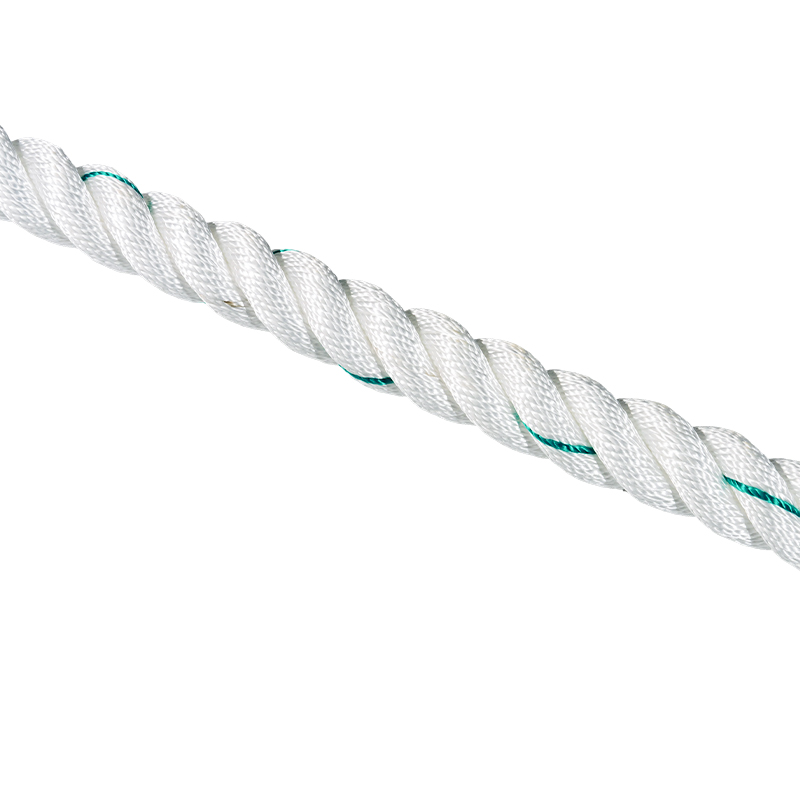
The traditional marine construction for polyamide, three-strand twisted rope, remains widely specified because its geometry contributes directly to shock performance. Under dynamic loading, the helical twist angle of the strands flattens slightly, allowing additional elongation beyond what the fiber alone provides. This geometric elongation supplements the fiber's inherent elasticity, giving three-strand polyamide among the highest effective elongation of any rope construction.
Splicing capability is also exceptional in three-strand construction. A properly executed eye splice in three-strand polyamide retains 85% to 95% of the rope's rated break strength, allowing termination hardware to be integrated without introducing the stress concentration that rope-to-metal mechanical clamps inevitably create.
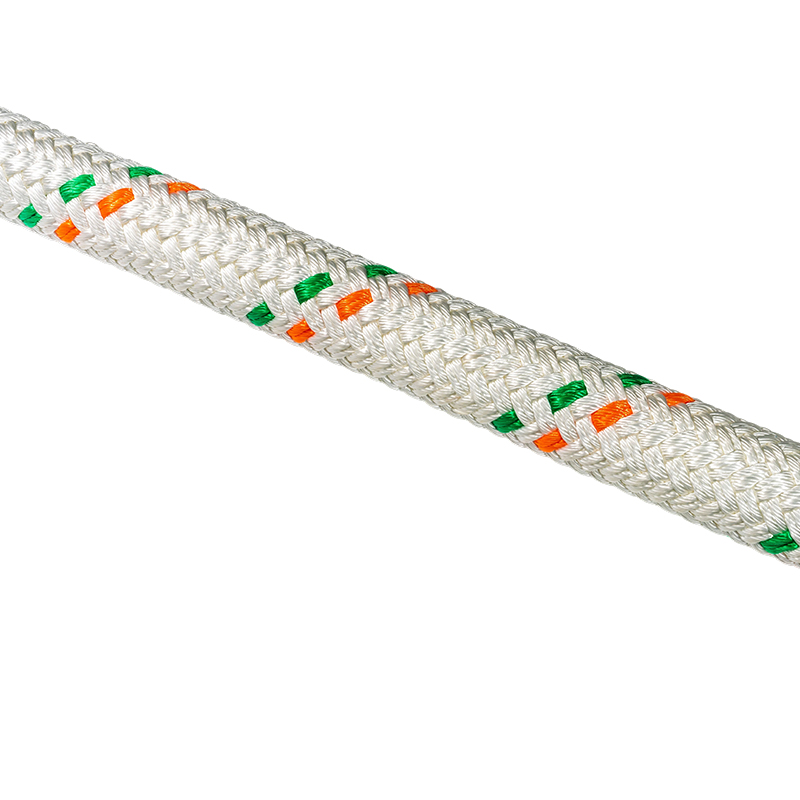
Double braid polyamide, with a braided core surrounded by a braided cover, offers improved handling, reduced hockle tendency, and a more consistent circular cross-section that feeds smoothly through fairleads and over capstans. The tradeoff is marginally lower elongation compared to three-strand for equivalent diameter, as the braided geometry restrains the fiber from reaching its full theoretical elongation before the construction locks up.
For applications where handling quality and torque neutrality matter, double braid is preferred. For maximum shock absorption where only raw energy dissipation capacity is the criterion, three-strand remains technically superior.
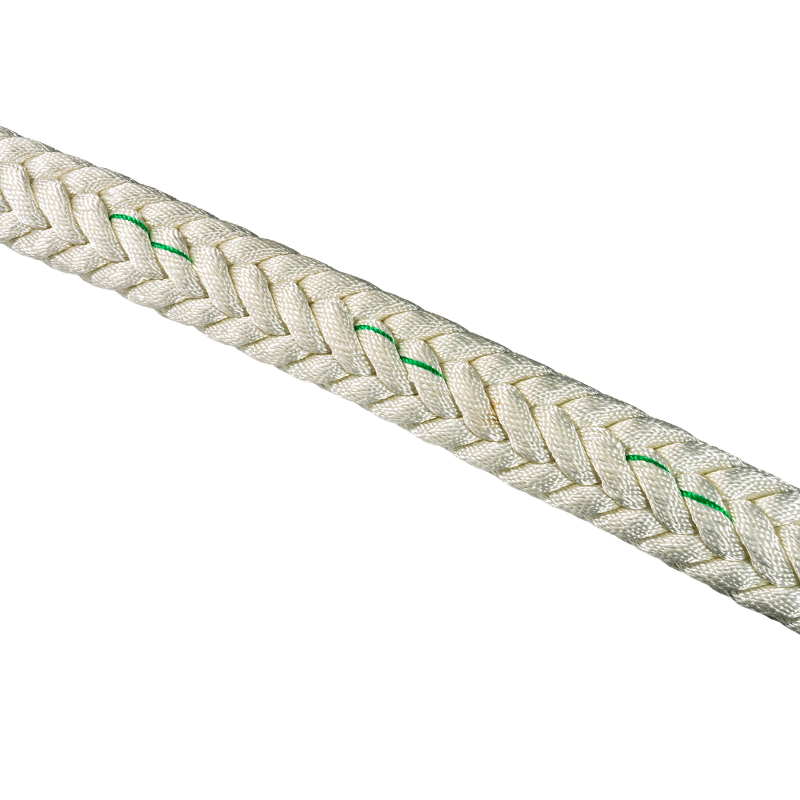
For high-load applications such as offshore mooring and heavy commercial towage, some manufacturers produce kernmantle polyamide ropes with a parallel-filament core optimized for strength and a braided sheath optimized for abrasion resistance. These constructions allow the core geometry to be engineered independently of the cover, enabling fine-tuning of the elongation profile across the working load range.
Shock-resistant polyamide marine ropes are specified wherever dynamic load spikes are a foreseeable operational condition, which in practice covers a significant portion of all working rope applications in the marine environment.
In commercial towage, the catenary shape of a tow hawser between the tug and the tow provides a geometric damping effect, but when the tow accelerates and removes the catenary, the rope must absorb a significant dynamic load spike without failure. Polyamide's elongation budget provides the necessary compliance margin that allows the system to survive repeated such events over a long tow passage.
In vessel mooring, swell and vessel traffic generate regular surging loads that a low-elongation mooring line would transmit directly to the vessel's bitts and cleats as cyclic fatigue loads. Polyamide mooring lines act as compliant springs in the mooring system, preventing fatigue accumulation in the vessel's deck fittings and reducing wear at the berth itself.
Anchor rodes in polyamide perform a similar function: the stretch in the line absorbs pitching and surging loads before they are transmitted to the anchor, reducing anchor dragging risk in conditions where a chain-only rode would transmit every wave load directly to the anchor flukes.
| Property | Polyamide (Nylon) | Polyester | Polypropylene | HMPE (Dyneema) |
|---|---|---|---|---|
| Shock absorption | Excellent | Moderate | Moderate | Poor |
| Elongation at break | 25-40% | 12-18% | 20-30% | 2-4% |
| Tensile strength (relative) | High | High | Moderate | Very High |
| UV resistance | Moderate | Good | Poor (untreated) | Good |
| Floats in water | No | No | Yes | No |
| Chemical resistance | Moderate | Good | Good | Excellent |
| Abrasion resistance | Good | Good | Poor | Good |
| Wet strength retention | 85-88% | 97-99% | 100% | 100% |
| Primary marine use | Mooring, towing, anchoring | Running rigging, halyards | Safety lines, throwlines | Performance running rigging |
The comparison makes clear that no single fiber dominates across all marine properties. Polyamide's pre-eminence in shock-resistant applications reflects its specific combination of high elongation and high strength. Where elongation is a disadvantage, such as in halyards and control lines where precise sail trim requires minimal stretch, polyester or HMPE are correctly preferred. Selecting rope fiber on a single property in isolation, such as choosing HMPE for mooring because it is stronger, ignores the dynamic load behavior that actually governs mooring line failures.
Polyamide's principal weakness relative to polyester and HMPE is susceptibility to UV photodegradation. Prolonged exposure to ultraviolet radiation progressively breaks the amide bonds in the polymer backbone, reducing tensile strength and, critically, reducing elongation-at-break. A UV-degraded polyamide rope may still show acceptable tensile strength on a pull-test while having lost significant shock absorption capacity, because the elongation reduction is proportionally greater than the strength reduction.
UV stabilizers incorporated into fiber during manufacturing extend resistance significantly, and dark pigmentation, particularly black and navy, reduces UV penetration into the fiber bundle. Ropes stored or deployed in high-UV environments should be covered when not in use, and inspection protocols should include elongation testing, not just strength assessment.
Polyamide is vulnerable to strong acids, which hydrolyze the amide bond and cause rapid strength loss. In marine environments, the principal acid exposure risks are battery acid in engine rooms, acidic bilge contamination, and some antifouling compounds. Alkalis degrade polyamide more slowly but cumulatively. Any rope that has been exposed to chemical contamination of unknown composition should be retired rather than returned to service, as visual inspection cannot reliably reveal chemically induced internal degradation.
Repeated high-load shock events, even at loads well below the rope's break strength, progressively accumulate internal damage through inter-fiber abrasion and localized heat generation. Heat is particularly damaging: polyamide begins to lose strength above 120C and melts at approximately 215C to 225C. Under rapid cyclic loading on a capstan or drum, surface temperatures can reach damaging levels that are not apparent from exterior inspection.
Glazed or fused fiber surfaces suggest heat damage. Powdering or chalking of fiber surfaces indicates UV degradation. Flat or compressed sections in a previously round rope suggest overloading. Cuts, abrasion, and kinks are visible indicators of mechanical damage requiring immediate assessment.
Retire a polyamide marine rope when diameter has reduced more than 10% from nominal, when visible internal fiber damage is present on strand separation, after any shock loading event that felt severe enough to be unusual, or at a defined calendar interval regardless of apparent condition in high-consequence mooring applications.
Minimum break strength, MBS, is the manufacturer's tested value for a new rope under controlled test conditions. Working load limit, WLL, is MBS divided by a safety factor that accounts for in-service degradation, dynamic loading, knot efficiency, and consequence of failure. For shock-resistant polyamide marine ropes in mooring applications, typical safety factors range from 5:1 for low-consequence berthing lines to 10:1 or higher for towing and salvage operations where dynamic load multipliers are large and failure consequences are severe.
These safety factors are not conservative engineering timidity. They reflect the real difference between the static test load at which the rope was certified and the actual dynamic peak loads it will encounter in service. A rope specified to a 5:1 safety factor in mooring will, on a rough day, experience peak dynamic loads that exhaust approximately half of its safety margin. Reducing safety factors to save cost or weight in working marine rope is a well-documented cause of preventable failures.
For a given MBS requirement, there is a practical advantage to using longer, larger-diameter polyamide mooring lines rather than shorter, smaller-diameter lines. A longer rope has more fiber length to elongate, meaning the same percentage elongation absorbs a much larger absolute energy quantity. This is the engineering principle behind using full-length mooring lines rather than short pendants where shock absorption is the priority.
Establish the maximum expected static working load and estimate the dynamic multiplier for the application. Towing in open water with significant catenary may have a multiplier of 2x to 3x; straight-pull mooring in swell conditions can reach 5x to 8x peak-to-static ratio.
Apply your selected safety factor to the estimated dynamic peak load, not to the static working load, to arrive at the minimum break strength requirement for the rope specification.
Choose three-strand for maximum elongation and easy field splicing, double braid for handling quality and fairlead compatibility, or kernmantle for heavy commercial loads.
Require a test certificate traceable to a recognized standard such as ISO 9554, EN 919, or the relevant OCIMF MEG4 guideline for mooring equipment. Verify that the MBS figure is for the complete rope, not for the fiber alone.
Define in writing the inspection frequency, the criteria that trigger immediate retirement, and the maximum calendar service life regardless of condition. Document this alongside the rope's installation record.
Shock-resistant polyamide marine ropes used in professional applications are subject to a layered framework of standards that govern testing methodology, minimum performance requirements, and certification traceability.
ISO 9554 defines general requirements and test methods for fibre ropes in marine and offshore applications, including tensile testing protocols, elongation measurement methods, and marking requirements. EN 919 covers the equivalent European framework with specific performance classes for different application categories. For offshore mooring and tanker operations, OCIMF's Mooring Equipment Guidelines, now in their fourth edition, provide the most operationally specific guidance available, including dynamic load modeling methodology and mooring line inspection criteria that go beyond what generic rope standards address.
For workboat and commercial towing applications, national maritime authority requirements such as those from MCA, DNV GL, and Lloyd's Register impose additional type approval requirements on ropes used in safety-critical roles. Procurement specifications for these applications should require type approval documentation alongside the manufacturer's own test certificates.
The established dominance of polyamide in shock-resistant marine applications does not mean the material has reached its performance ceiling. Active development programs are advancing several aspects of polyamide rope technology that will extend its performance range and service life in coming years.
High-tenacity polyamide fiber grades, produced through gel-spinning and controlled draw-ratio processing, achieve tensile strength values 30% to 45% higher than standard textile-grade nylon while preserving the elongation characteristics that define shock resistance. These fibers are entering commercial production at volumes that will make them accessible for professional marine rope applications beyond the current aerospace and specialty markets where cost has limited uptake.
UV stabilizer chemistry has advanced significantly, with hindered amine light stabilizer packages now capable of extending UV resistance by a factor of two to three compared to earlier additive formulations. Combined with UV-absorbing pigment systems, next-generation polyamide marine ropes will have substantially improved outdoor service lives without the elongation compromise that fiber blending with UV-resistant fibers has historically introduced.
Hybrid constructions that combine a polyamide shock-absorbing core with a high-tenacity polyester or HMPE outer braid are gaining traction in applications where low-stretch handling is required for routine operations but shock resistance must be preserved for emergency load events. These constructions present a bi-linear load-elongation profile: stiff at low loads for precise handling, compliant under shock loads where the outer braid reaches its geometric extension limit and the polyamide core takes over as the primary load-carrying element.
Condition monitoring technology developed for offshore umbilicals and power cables is being adapted to marine rope applications. Embedded fiber optic sensors running through the rope's core can monitor distributed strain in real time, enabling load history logging, fatigue cycle counting, and anomalous load event detection. For high-value mooring systems such as SPM tanker loading buoys and FPSO mooring legs, the cost of smart rope instrumentation is justified by the operational and safety value of continuous condition data that replaces scheduled visual inspections with evidence-based remaining service life assessment.
Mar 12. 2026
What Are the Most Common Practical Uses for Polypropylene Rope?Core Applications of Polypropylene Rope in Marine and Water Activities In the modern rope industry, Polypropylene Rope (often referred to as “PP rope” or “floating rope”) has become an irreplaceable tool for water-based ...
Read MoreMar 12. 2026
Polyester Rope Guide: Types, Uses, Strength & Buying TipsPolyester rope is one of the most versatile and reliable cordage options available today. It outperforms nylon in UV resistance, holds its strength when wet, and stretches far less under load — making it the preferred c...
Read MoreMar 13. 2026
What is polyester rope and why is it the best choice for most applicationsWhat Is Polyester Rope? Understanding the Basics Polyester rope is one of the most widely used synthetic ropes in the world today, valued across industries for its exceptional balance of strength, durability, and resista...
Read More


 English
  русский
  Español
  عربى
عربى