2026.06.10
 Industry News
Content
Shock loading occurs whenever the rate of force application significantly exceeds the natural response time of the system. In practical rope applications, this encompasses vessel mooring line snap loads during sudden wave action, dynamic arrest of a falling or swinging suspended load, towline engagement at speed, and anchor deployment events. The defining characteristic is not the magnitude of the final load, but the rate at which it rises — the load rate, expressed in kilonewtons per second.
Classical impact mechanics describes the peak dynamic force transmitted through a rope system as a function of both the kinetic energy of the moving mass and the stiffness of the connecting element. A perfectly rigid connection transmits the full theoretical impact force instantaneously. A compliant connection — one that elongates under load — spreads the same energy absorption over a longer time interval, reducing peak force in proportion to the square root of the stiffness reduction. This is the fundamental operating principle of any shock-absorbing rope system.
Polyamide converts dangerous instantaneous peak forces into time-distributed stress that structures, hardware, and connections can safely withstand.
A critical and often misunderstood point is that rope elongation does not mean energy is lost from the system — it means the same energy is absorbed over a longer displacement and time, reducing the peak force transmitted to end fittings, anchor points, winch drums, crane hooks, and structural connections. It is this force reduction, not energy reduction, that protects the system.
The exceptional shock absorption of polyamide rope is not an incidental material property — it arises from a precisely defined hierarchy of molecular and microstructural mechanisms operating simultaneously across different length scales.
Polyamide's semicrystalline structure contains disordered amorphous regions between ordered crystalline lamellae. Under shock tension, these amorphous chain segments uncoil and extend, absorbing large amounts of deformation energy before crystalline domains are stressed.
The amide groups (-CONH-) along nylon's backbone form reversible hydrogen bonds with adjacent chains. Under rapid loading, these bonds progressively break and re-form, dissipating energy through each bond-rupture event across billions of molecular sites.
Polyamide exhibits pronounced viscoelastic behavior: its mechanical response is both elastic (recoverable deformation) and viscous (time-dependent, energy-dissipating). This dual behavior is precisely what makes it a natural damper — unlike purely elastic materials that store and return all energy.
At the rope level, the helical geometry of yarns and strands in twisted and braided constructions provides additional compliance through geometric reorientation — strands straighten toward the rope axis before fiber-level elongation begins, contributing further to shock absorption.
Why moisture aids shock performance: Nylon's capacity to absorb water (up to 8% by weight in PA6) is often cited as a drawback, but in shock absorption applications it is partially beneficial. Water molecules plasticize the amorphous regions, increasing chain mobility and extending the viscoelastic response — wet nylon rope is measurably more compliant and absorbs slightly more impact energy per unit elongation than dry rope, at some cost to static breaking strength.
The shock absorption performance of rope systems is quantified through standardized dynamic testing that subjects rope samples to controlled drop-weight or pendulum impact events, measuring both peak force transmitted and total energy absorbed. Industry standards including EN 1891, ISO 10333, and DNVGL-OS-E301 specify test protocols appropriate to personal fall protection, offshore mooring, and industrial lifting applications respectively.
| Fiber Type | Elongation at Break | Shock Absorption | Energy Stored (relative) | Peak Load Reduction | Creep Risk |
|---|---|---|---|---|---|
| Polyamide (PA6/66) | Excellent | 35-45% | Moderate | ||
| Polyester | Good | 15-25% | Low | ||
| HMPE (Dyneema) | Poor | Minimal | High | ||
| Aramid (Kevlar) | Poor | Minimal | Very Low | ||
| Polypropylene | Moderate | 20-30% | High | ||
| Manila (natural) | Fair | 5-12% | Moderate |
The data establishes clearly that polyamide occupies a unique performance position: the highest elongation and shock absorption of any major synthetic fiber while maintaining sufficient tensile strength for structural lifting and mooring duties. HMPE and aramid, despite their superior strength-to-weight ratios, transmit shock loads nearly intact to end connections — in shock-dominated applications, their high stiffness is a liability, not an asset.
The molecular properties of polyamide fiber define the upper bound of shock absorption performance. The constructional geometry of the rope determines what fraction of that potential is realized in service — and how it changes with damage, wear, and repeated loading cycles.
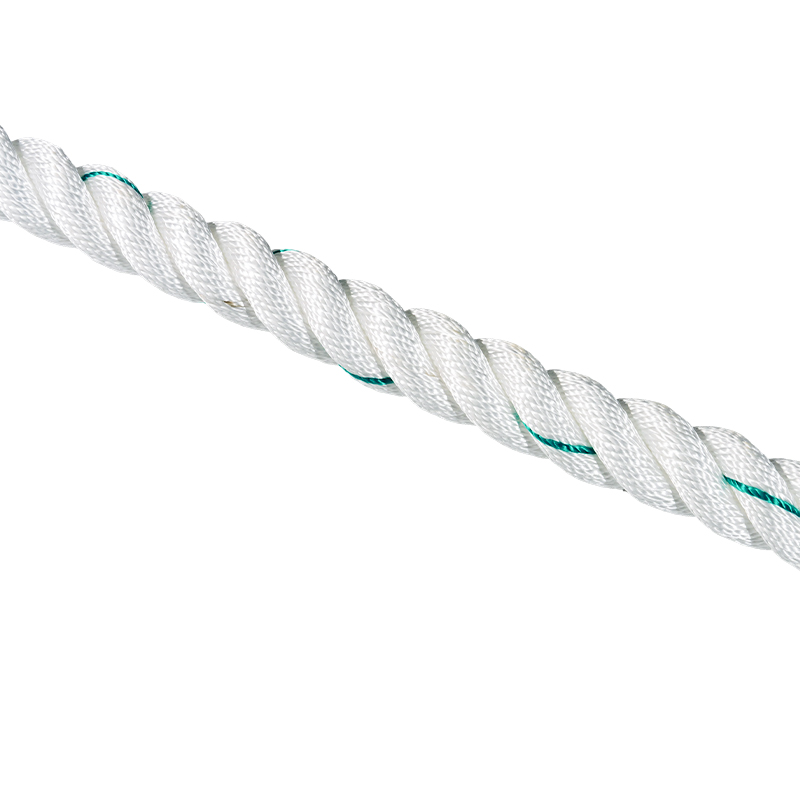
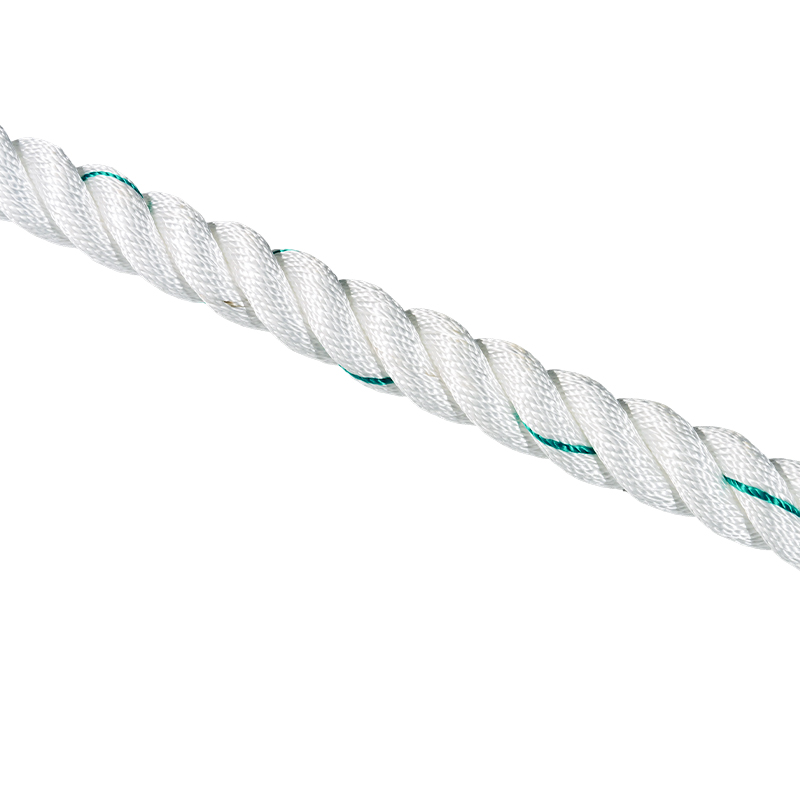
Traditional 3-strand twisted polyamide rope is, in engineering terms, a two-stage compliance system. Under initial tension, the helical strands rotate toward the rope axis, contributing geometric elongation before any fiber-level stretch begins. This geometric stage can account for 5 to 8 percent of total elongation, supplementing the 20 to 25 percent from fiber-level viscoelastic response. The combined elongation in a 3-strand polyamide rope under shock can reach 28 to 35 percent — making it among the most compliant structural fiber rope available.
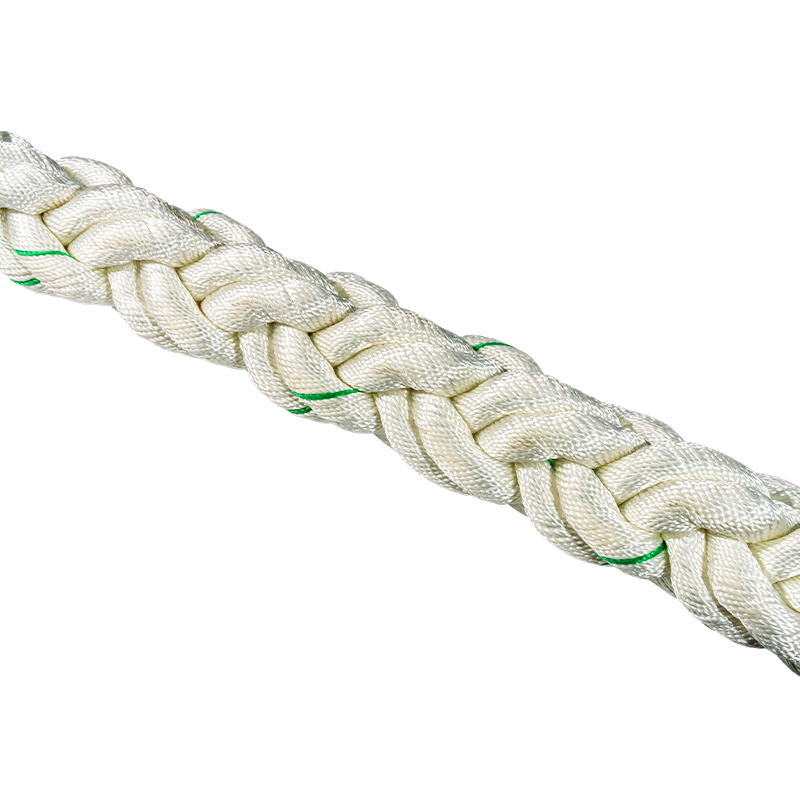
8-strand plaited constructions reduce the torque imbalance of 3-strand rope while preserving most of the elongation benefit. The paired opposing lay of the eight strands eliminates net twist generation under load, making the 8-strand format preferred for lifting applications where load rotation is hazardous, without significantly compromising shock absorption.
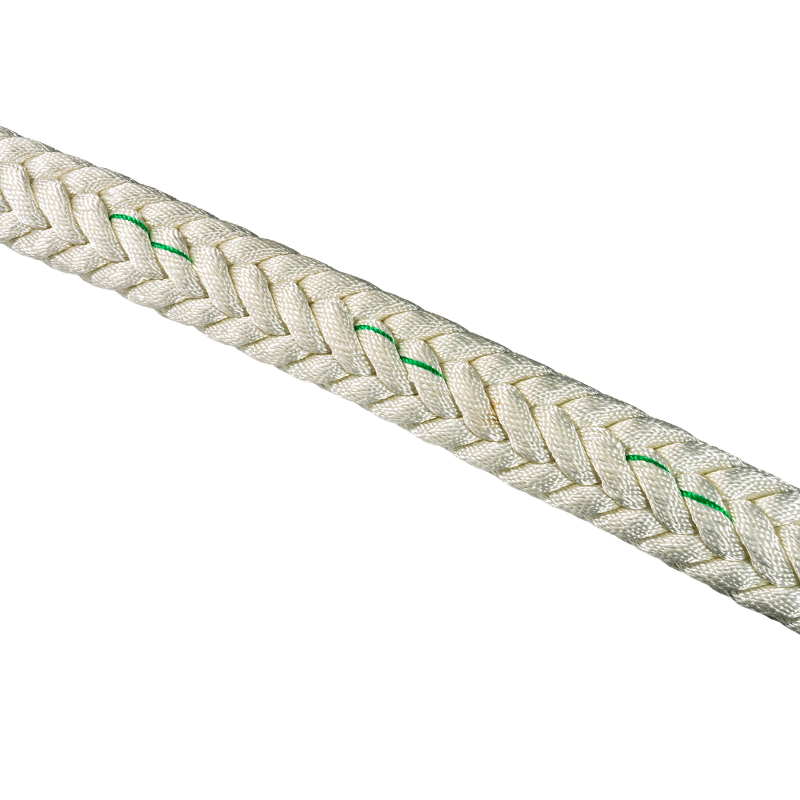
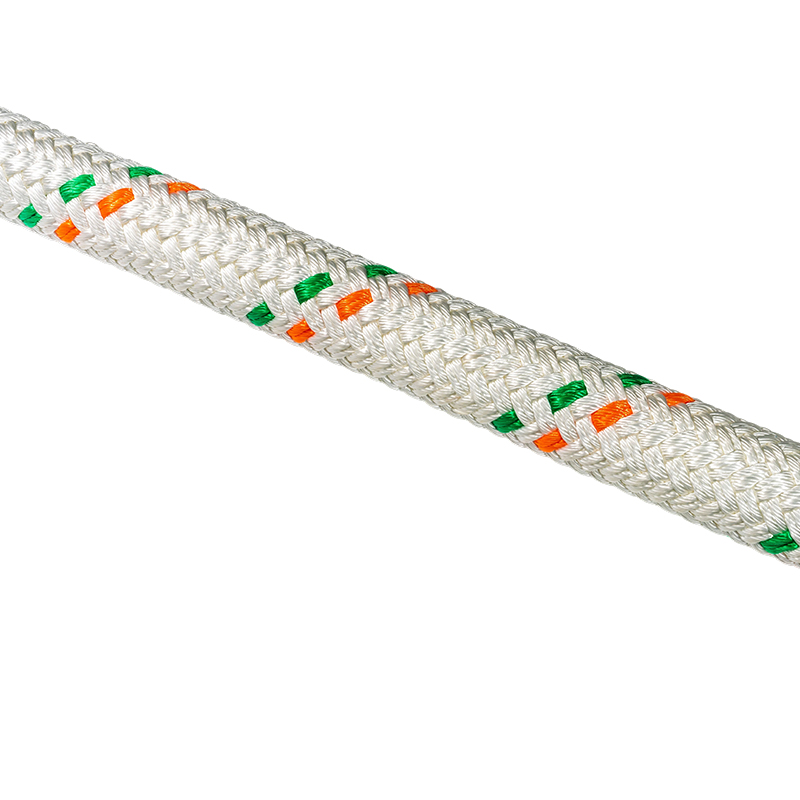
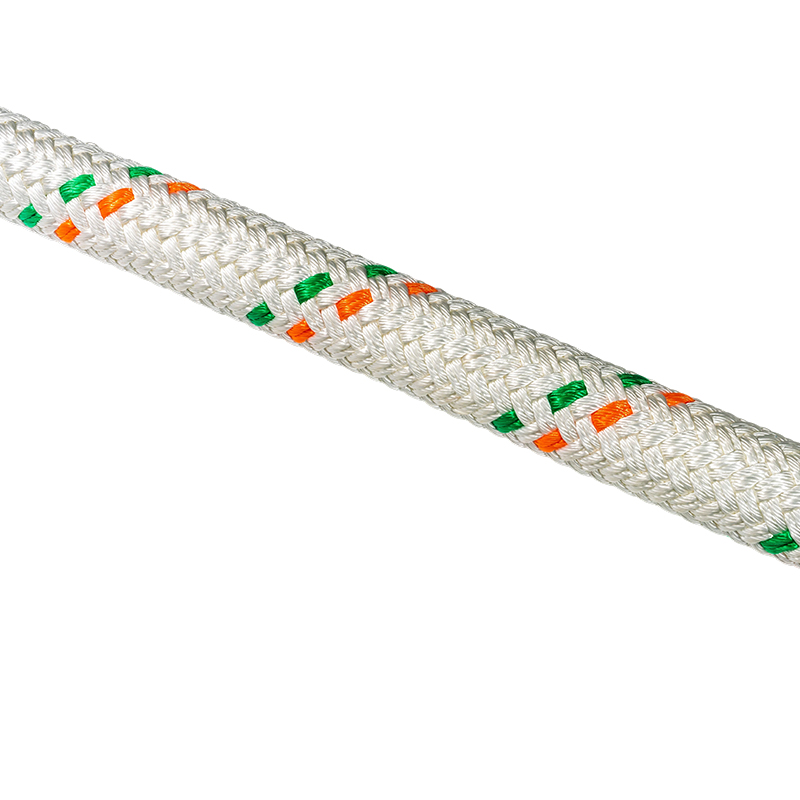
In double-braid polyamide constructions, an inner braided core carries the primary load while an outer braided cover provides abrasion and UV protection. The load-sharing ratio between core and cover influences effective elongation: covers with slightly lower initial modulus than the core allow the core to elongate before the cover becomes fully engaged, effectively tuning the rope's stiffness curve to maintain high elongation through mid-load ranges where shock events typically occur.
Design principle for shock-critical applications: Rope constructions with a high lay angle (steep helix) deliver more initial geometric compliance, reaching their working elongation range at lower loads. Rope with a low lay angle achieves higher strength but lower elongation. For shock absorption duty, specifiers should explicitly request high-lay-angle construction from rope manufacturers — the difference in shock performance between nominally identical diameter ropes can exceed 15 percent.
The shock absorption properties of polyamide rope are not simply desirable across these applications — they represent the primary engineering justification for material selection over higher-strength but lower-elongation alternatives.
Polyamide spring lines on tanker and LNG vessel mooring arrangements absorb the kinetic energy of vessel surge during berthing and under swell conditions. Without elastic compliance in the mooring system, vessel movements of 0.3 to 0.5 meters at line speed generate snap loads that regularly exceed 150 percent of static mooring tension. Nylon spring lines have been shown to reduce snap load frequency by over 60 percent in exposed berth configurations subject to long-period swell.
EN 355 and ANSI Z359.13 shock-absorbing lanyards use tightly folded nylon webbing packs that tear progressively under fall arrest forces, limiting the maximum arresting force transmitted to the harness wearer to below 6 kN regardless of fall distance. The controlled elongation of the nylon webbing and stitching provides the compliance needed to decelerate a falling body without exceeding human tolerance limits for thoracic and spinal loading.
Nylon towing pendants inserted between the tug's tow hook and the main wire or synthetic towing line serve as shock absorbers for the entire towing system. In heavy weather towing, vessel motions in a seaway generate cyclical load variations that would fatigue rigid connections within hours. The nylon pendant extends the load cycle period, reduces peak-to-trough variation, and significantly extends the fatigue life of both the main tow wire and the tug's stern gear.
Structural steelwork, precast concrete panels, and modular equipment pieces require lateral control during crane lifting. Polyamide tag lines allow ground workers to guide loads without rigid connection. If a load swings suddenly, the nylon's elongation prevents the instantaneous jerk that a polypropylene or steel wire tag line would transmit to the ground worker, dramatically reducing the risk of wrist, elbow, and shoulder injury from shock loading.
Recreational and commercial vessels using polyamide anchor rodes benefit from continuous shock absorption against wind gusts, wave action, and tide-driven load variations. The nylon rode stretches under peak loads, preventing anchor dislodgement from sudden tensile spikes while the controlled return of elastic energy as the load eases prevents the catastrophic rode failure from fatigue that characterizes chain rodes in short, steep chop conditions.
Transition piece and monopile installation operations use polyamide pendant lines and tag lines to control component orientation from installation vessels. Wave-induced vessel motion at the hook point generates dynamic loads during mating operations; nylon lines absorb these dynamics, protecting expensive components from impact damage during the critical final meters of installation that rigid slings cannot safely accommodate.
Shock absorption performance must be evaluated not only at first loading but across the cumulative loading history of the rope in service. Polyamide rope exhibits progressive fatigue under repeated dynamic loading, and understanding this degradation trajectory is essential for safe service life management.
Research on offshore mooring polyamide pendants has shown that shock absorption performance — measured as elongation under a standard drop-weight impact — can decrease by 12 to 18 percent after 10,000 loading cycles at 30 percent of breaking load. This degradation accelerates significantly at higher load ratios. For shock-critical applications, retirement criteria based on dynamic performance testing rather than static visual inspection alone provide substantially better risk management outcomes.
A rope that has lost 20 percent of its elongation capacity has not lost 20 percent of its breaking strength — but it may have lost 35 percent of its shock absorption capacity. Static inspection alone cannot reveal this degradation. In shock-governed applications, the elongation is the safety margin, not the break load.
High-performance polyamide rope achieves its maximum shock mitigation potential only when deployed within a system that is designed to exploit its compliance. This requires engineering attention beyond the rope itself to the end fittings, attachment geometry, and operational procedures.
The efficiency of shock energy absorption in a polyamide rope depends critically on the length of rope participating in the elongation event. Short rope lengths generate high stiffness despite high elongation-per-unit-length — the total displacement available is proportional to rope length multiplied by elongation percentage. A nylon pendant that is 2 meters long absorbs far less energy in a shock event than the same rope at 10 meters. System designers specifying nylon for shock absorption must ensure that the nylon element is of sufficient free length to develop meaningful compliance.
The most sophisticated shock management systems combine polyamide's compliance with the geometric stability and low creep of high-modulus synthetics. In a hybrid mooring line, an HMPE or polyester main leg provides the structural backbone and limits maximum excursion, while a nylon tail or pendant absorbs dynamic loads before they reach the high-modulus section. Load cell monitoring in North Sea FPSO hybrid mooring trials has demonstrated that properly sized nylon tails reduce peak tensile events in the HMPE legs by 28 to 38 percent compared to direct HMPE connection to the vessel — directly translating into extended chain and hardware fatigue life.
The increasing deployment of inline load monitoring shackles and smart rope systems with embedded optical fiber sensors is enabling real-time quantification of shock events in polyamide mooring and lifting systems. By logging peak load versus time profiles, operators can identify when cumulative shock event counts or magnitudes have reached thresholds associated with accelerated fatigue degradation, triggering inspection or replacement before performance falls below safety margins. This data-driven approach represents the maturation of polyamide shock rope deployment from empirical art to quantified engineering practice.
Selecting a polyamide rope for shock absorption duty requires balancing several interconnected parameters. The following framework reflects current best practice among offshore and industrial rigging engineers.
| Design Parameter | Recommendation for Shock Duty | Rationale |
|---|---|---|
| Fiber grade | PA6 or PA66, high-tenacity industrial grade | Higher molecular weight improves fatigue resistance under cyclic shock |
| Construction | 3-strand or 8-strand plaited for maximum elongation; double braid for abrasion protection | High lay angle maximizes geometric contribution to elongation |
| Rope length | Minimum 3-5m free length in the elastic zone | Shorter lengths develop insufficient total elongation for meaningful energy absorption |
| Load ratio | Size to operate at 15-25% MBL under normal loads | Preserves elongation reserve for shock events without overstressing fiber |
| Inspection interval | Dynamic performance check every 12 months or after major shock event | Static inspection misses elongation-fatigue degradation |
| UV/marine treatment | UV stabilizer package mandatory for outdoor deployment | UV degradation primarily affects amorphous regions — the same zones responsible for shock absorption |
High-performance polyamide rope shock absorption is not a passive material property but an active engineering tool — one that must be deliberately designed into systems, correctly specified in terms of grade, construction, and length, and systematically managed through the rope's operational life. The molecular mechanisms of viscoelastic energy dissipation, the constructional geometry of lay and braid angle, and the system-level integration with hybrid fiber and monitoring technologies together define a sophisticated discipline that goes far beyond selecting rope from a catalogue. As offshore energy infrastructure, lifting complexity, and safety expectations all continue to rise, the precise engineering of polyamide rope shock performance will remain a cornerstone of structural protection across the most demanding environments on earth.
Mar 12. 2026
What Are the Most Common Practical Uses for Polypropylene Rope?Core Applications of Polypropylene Rope in Marine and Water Activities In the modern rope industry, Polypropylene Rope (often referred to as “PP rope” or “floating rope”) has become an irreplaceable tool for water-based ...
Read MoreMar 12. 2026
Polyester Rope Guide: Types, Uses, Strength & Buying TipsPolyester rope is one of the most versatile and reliable cordage options available today. It outperforms nylon in UV resistance, holds its strength when wet, and stretches far less under load — making it the preferred c...
Read MoreMar 13. 2026
What is polyester rope and why is it the best choice for most applicationsWhat Is Polyester Rope? Understanding the Basics Polyester rope is one of the most widely used synthetic ropes in the world today, valued across industries for its exceptional balance of strength, durability, and resista...
Read More


 English
  русский
  Español
  عربى
عربى