English
  русский
  Español
  عربى
عربى 



The materials used to make rope have a direct impact on its strength, flexibility, durability, and suitability for different environments. From plant-based natural fibers that have served humanity for thousands of years to engineered synthetic polymers developed in the 20th century, the range of rope materials available today covers nearly every conceivable application. Understanding the properties of each material is essential for selecting the right rope for any task.
What Makes a Good Rope Material
Not every fiber is suitable for making rope. A practical rope material must possess a combination of properties that allow it to be processed into usable cordage and perform reliably under load. The key characteristics evaluated when selecting rope materials include:
- Tensile strength: The ability to resist breaking under a pulling force. Higher tensile strength allows a thinner rope to carry a given load.
- Elongation: How much the rope stretches before breaking. High elongation absorbs shock loads; low elongation provides precise load control.
- Abrasion resistance: The ability to withstand surface wear from friction against hardware, rock, bark, or other rough surfaces.
- Resistance to moisture: Whether the material absorbs water, and how water affects its strength and handling characteristics.
- UV resistance: The ability to withstand degradation from prolonged exposure to sunlight.
- Chemical resistance: Tolerance to oils, acids, alkalis, and other substances encountered in industrial or marine environments.
- Weight and density: Relevant for applications where a lightweight rope is preferred, or where buoyancy is required.
No single material scores well on every criterion. Choosing the right rope material always involves trade-offs based on the specific demands of the application.
Natural Fiber Materials for Rope
Natural fibers were the only materials available for rope-making until synthetic polymers became widely accessible in the mid-20th century. Many natural fiber ropes remain in use today for their aesthetic appeal, biodegradability, and suitability for low-load applications.
Manila (Abacá)
Manila fiber is extracted from the leaf stalks of the abacá plant (Musa textilis), grown primarily in the Philippines. It has long been regarded as one of the more capable natural fiber rope materials, offering good tensile strength, natural resistance to salt water, and reasonable UV tolerance. Manila rope was historically the preferred choice for maritime rigging, fishing nets, and cargo handling.
Its main weaknesses are susceptibility to rot when stored in damp conditions and a tendency to shrink when wet. Today, manila rope is widely used in decorative, agricultural, and landscaping applications where its natural appearance is valued.
Sisal
Sisal fiber comes from the leaves of the Agave sisalana plant, which is cultivated across tropical regions of Africa, Brazil, and Asia. It is one of the more widely produced natural rope fibers globally. Sisal rope is stiff, coarse, and biodegrades readily, making it a popular choice for agricultural twine, baling, packaging, and garden use. Its tensile strength is lower than manila, and it absorbs moisture readily, which limits its use in wet or marine environments.
Hemp
Hemp fiber, derived from the stalks of Cannabis sativa, has been used to make rope for thousands of years. It offers a higher tensile strength than sisal, good resistance to UV light, and reasonable durability. Hemp rope was a cornerstone of sailing ship rigging in Europe and Asia for centuries. Today, it is popular in craft, decorative, and sustainability-focused applications due to its natural origin and biodegradability. It is also used in traditional rigging reproductions and theatrical applications.
Jute
Jute is one of the affordable natural rope fibers, sourced from the stalks of Corchorus plants grown primarily in South Asia. It is soft relative to sisal and has a natural golden sheen, but its tensile strength is relatively low and it absorbs moisture quickly. Jute biodegrades rapidly and is suitable for short-term, light-duty tasks such as garden twine, packaging, and crafts. It is not recommended for load-bearing or outdoor applications involving prolonged moisture exposure.
Coir (Coconut Husk Fiber)
Coir is extracted from the fibrous outer husk of coconut shells and has been used in rope-making across South Asia and the Pacific for centuries. It is naturally buoyant and highly resistant to salt water, which made it valuable in traditional maritime applications. Coir rope has a degree of natural elasticity that helps it absorb shock loads. However, its tensile strength is lower than other natural fibers, and it is heavier and bulkier for a given rope diameter. It remains in use for mooring, matting, and craft applications.
Cotton
Cotton rope is made from the seed fibers of the Gossypium plant. It is softer and more flexible than other natural fiber ropes, with a smooth surface that is gentle on the hands and on surfaces it contacts. Cotton rope is well-suited for decorative work, macramé, pet toys, clotheslines, and stage rigging where skin contact is frequent. It has poor resistance to moisture, UV light, and abrasion, and should not be used in demanding load-bearing or outdoor applications.
Linen (Flax)
Linen fiber, derived from the flax plant (Linum usitatissimum), was one of the earliest rope materials used in ancient Egypt and the Mediterranean. It is stronger than cotton and has reasonable moisture resistance. Today, linen rope is primarily found in historical reproductions, specialty craft applications, and traditional rigging where authenticity is a priority.
Synthetic Fiber Materials for Rope
The development of synthetic polymer fibers in the 20th century transformed rope manufacturing. Synthetic materials generally offer greater consistency, higher strength-to-weight ratios, and better resistance to moisture, UV, and chemicals than natural fibers. They now dominate commercial, industrial, and professional rope applications worldwide.
Nylon (Polyamide)
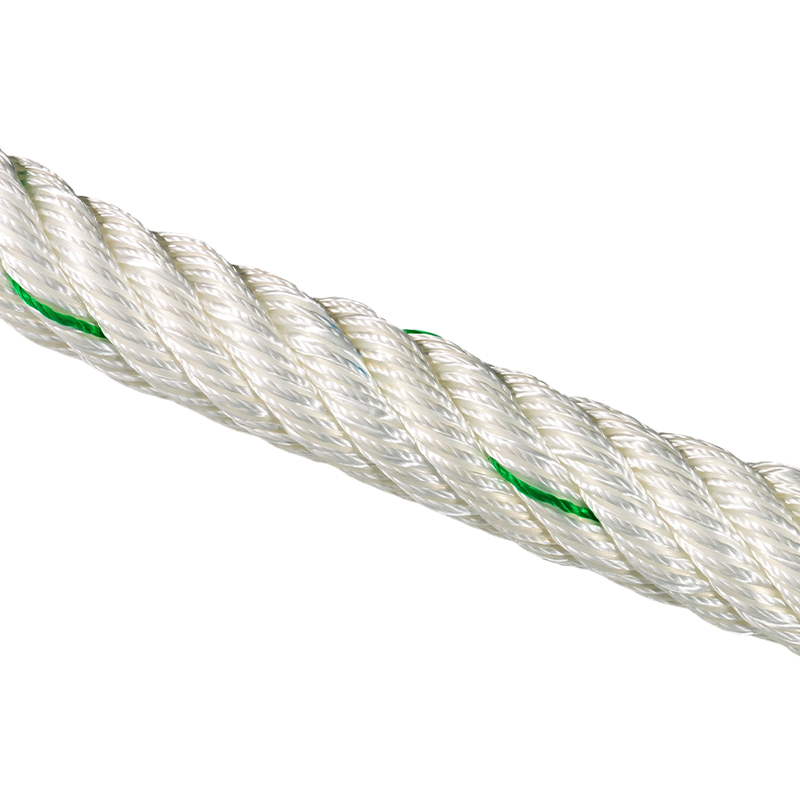
Nylon was one of the synthetic rope materials to gain widespread use and remains highly valued for its unique combination of high strength and high elongation. Nylon rope can stretch 15–28% before breaking, absorbing energy from sudden shock loads and releasing it gradually. This makes it the preferred material for anchor lines, tow ropes, and dynamic climbing ropes where buffering sudden loads is critical.
Nylon absorbs water and loses approximately 10–15% of its break strength when wet. It is also susceptible to UV degradation over time and to damage from acids. Despite these limitations, nylon's shock-absorbing properties make it irreplaceable in a number of key applications.
Polyester (PET)
Polyester rope is one of the widely used synthetic rope materials, valued for its combination of strength, low elongation, UV resistance, and moisture stability. Unlike nylon, polyester retains almore all of its strength when wet, and it resists UV degradation significantly better. It does not float. Polyester rope is commonly used for sailing rigging, dock lines, halyards, arborist work, and general marine applications where dimensional stability and all-weather performance are priorities.
High-tenacity polyester, a denser and stronger variant, delivers improved break strength and abrasion resistance compared to standard polyester and is used in professional rigging and rescue systems.
Polypropylene
Polypropylene is the lightest common synthetic rope material and the only widely available rope fiber that floats on water. This buoyancy makes it the standard choice for water rescue throw bags, pool lane dividers, and water-ski tow lines. It is inexpensive and resists moisture well, but its UV resistance is poor — prolonged sun exposure causes it to become brittle and lose strength. Polypropylene rope is suited for short-term or indoor use, or applications where buoyancy is the primary requirement.
Polyethylene (Standard Grade)
Standard polyethylene rope is an economical synthetic option that also floats and resists moisture. It has lower tensile strength than nylon or polyester and is softer and more flexible than polypropylene. It is commonly found in agricultural, garden, construction, and general utility settings where cost efficiency and basic weather resistance are the main considerations rather than high load capacity.
High-Modulus Polyethylene — HMPE (Dyneema, Spectra)
Ultra-high-molecular-weight polyethylene (UHMWPE), sold commercially as Dyneema and Spectra, is a high-performance fiber that delivers a notably high strength-to-weight ratio among synthetic rope materials. A 10 mm HMPE rope typically achieves a break strength of 10–14 tonnes while being light enough to float. It has very low elongation, resistance to UV and moisture, and outstanding cut resistance.
HMPE is used in offshore mooring systems, yacht racing rigging, arborist climbing lines, military tethers, and industrial lifting slings. Its limitations include sensitivity to sustained heat above approximately 150°C, a tendency to creep under prolonged high loads, and a slippery surface that can make standard knots less reliable. Spliced terminations are strongly preferred over knots for HMPE rope.
Aramid Fiber (Kevlar, Twaron)
Aramid fibers — including Kevlar (DuPont) and Twaron (Teijin) — are para-aramid synthetic polymers known for their high tensile strength, very low elongation, and good heat resistance. Aramid rope maintains its structural integrity at temperatures that would cause HMPE to soften, making it suited to applications involving heat exposure such as fire rescue equipment, aerospace tethers, and industrial hoisting near heat sources.
Aramid fibers are sensitive to repeated bending and flexing, which causes progressive fatigue cracking. They also degrade under UV exposure, so aramid rope is almore always produced with a protective polyester or nylon sheath. Aramid rope does not float and is heavier than HMPE.
Liquid Crystal Polymer — LCP (Vectran)
Vectran, a liquid crystal polymer fiber produced by Kuraray, offers a combination of very high strength, near-zero creep, and good abrasion resistance. Unlike HMPE, Vectran does not creep under sustained load, which makes it particularly valuable in applications where a rope must hold a precise length under constant tension, such as precision rigging in racing yachts and scientific instrument tethers. It is sensitive to UV exposure and is therefore typically used in sheathed constructions.
Metal Wire as a Rope Material
Wire rope is constructed by twisting steel wires together in a helical pattern, mirroring the structure of fiber rope. It occupies a distinct performance category from fiber rope, offering very high tensile strength, minimal elongation, and resistance to heat, cutting, and abrasion that fiber ropes cannot match.
Galvanized Steel
Galvanized steel wire rope is coated with a layer of zinc to resist corrosion, making it suitable for outdoor and moderately wet environments. It is the standard material for crane hoists, elevator cables, mining equipment, and construction rigging. Break strengths for a 10 mm galvanized wire rope (6×19 construction) typically fall in the range of 6–8 tonnes, with very low elongation below 2%.
Stainless Steel
Stainless steel wire rope offers corrosion resistance compared to galvanized steel, making it the preferred choice for marine standing rigging, architectural cable systems, and food processing environments. It is more expensive than galvanized steel but requires less maintenance over time in corrosive conditions.
Wire rope's key disadvantages are its substantial weight, stiffness, and the difficulty of handling and inspection. It also does not absorb shock loads and will transmit sudden forces directly to anchor points and connected hardware.
Material Performance Comparison
The table below summarizes the key performance characteristics of the common rope materials to assist in material selection.
| Material | Tensile Strength | Elongation | UV Resistance | Moisture Resistance | Floats? | Biodegradable? |
|---|---|---|---|---|---|---|
| Manila | Medium | Low–Medium | Good | Poor (rots) | No | Yes |
| Sisal | Low–Medium | Low | Moderate | Poor | No | Yes |
| Hemp | Medium | Low–Medium | Good | Poor (rots) | No | Yes |
| Cotton | Low | Medium | Poor | Poor | No | Yes |
| Nylon | High | High (15–28%) | Moderate | Moderate (absorbs water) | No | No |
| Polyester | High | Low–Medium | Excellent | Excellent | No | No |
| Polypropylene | Medium | Medium | Poor | Excellent | Yes | No |
| HMPE (Dyneema) | Very High | Very Low (2–4%) | Excellent | Excellent | Yes | No |
| Aramid (Kevlar) | Very High | Very Low (2–4%) | Poor | Good | No | No |
| Steel Wire | Very High | Very Low (<2%) | Excellent | Good (galvanized) | No | No |
Hybrid and Composite Rope Materials
Many modern ropes combine two or more fiber types in a single construction to balance the strengths and weaknesses of each material.
Core-and-Sheath (Kernmantle) Construction
The kernmantle design uses a load-bearing core — often HMPE, aramid, or high-tenacity polyester — enclosed within a braided outer sheath of a different material. The sheath provides abrasion resistance, UV protection, and handleability while the core carries the primary load. Climbing ropes, technical rescue ropes, and high-performance sailing lines frequently use this construction to achieve performance that no single material can provide alone.
Blended Fiber Ropes
Some manufacturers blend two fiber types within a single strand or braid. For example, a blend of polyester and HMPE can reduce cost compared to pure HMPE while retaining much of the strength and low-elongation benefit. Polyester-nylon blends can adjust the elongation and abrasion resistance characteristics of a rope to suit specific applications.
Specialty Additions
Modern rope construction sometimes incorporates additional functional elements: reflective tracers woven into rescue ropes for night visibility; conductive fibers for grounding in electrical environments; color-coded marker yarns to identify rope type, length, or ownership; and fire-resistant treatments applied to sheaths used near heat sources.
How to Select the Right Rope Material
Choosing the appropriate material for a rope begins with a clear understanding of the working environment and load requirements. The following framework covers the more important selection criteria:
- Define the load requirements. Establish the max working load and apply the appropriate safety factor — typically 5:1 for general use and 10:1 for life-safety applications — to determine the min break strength needed.
- Consider the environment. Salt water, UV exposure, chemicals, heat, and abrasive surfaces all affect material performance differently. Match the material's resistance profile to the conditions it will face.
- Decide on elongation requirements. Applications involving shock loads benefit from high-elongation materials like nylon. Precision rigging and lifting applications require low-elongation materials like polyester or HMPE.
- Evaluate weight and buoyancy needs. HMPE and polypropylene are the lightest options and both float. Steel wire rope is heavy but may be the only practical option in high-heat or sharp-edge environments.
- Check applicable standards. Life-safety applications such as climbing, rescue, and fall arrest require materials and constructions certified to standards such as EN 892, EN 1891, or NFPA 1983.
- Balance cost against performance. Natural fibers and polypropylene are low-cost options for light-duty use. High-tenacity polyester offers a strong mid-range choice. HMPE and aramid provide higher performance at a substantially greater price.
- Consider sustainability. For applications where environmental impact is a priority, natural fiber ropes made from hemp, sisal, jute, or coir are fully biodegradable alternatives to synthetic materials.
Caring for Rope Materials
Regardless of the material, proper maintenance extends the service life of any rope and preserves its rated performance characteristics.
- Rinse synthetic ropes after marine use: Salt residue accelerates internal fiber abrasion. Rinse with fresh water and dry thoroughly before storage.
- Dry natural fiber ropes before storage: Hemp, manila, sisal, and cotton ropes are susceptible to mold and rot if stored damp. Hang loosely in a well-ventilated area to dry completely.
- Store away from UV exposure: Even UV-resistant materials like polyester degrade over time with prolonged direct sunlight. Store coiled ropes in bags or shaded lockers.
- Keep rope away from chemicals: Fuel, solvents, bleach, and battery acid can cause rapid and invisible degradation. Store rope away from chemical storage areas.
- Inspect regularly: Look for glazing, flat spots, core exposure, stiffness, or discoloration. Any of these signs warrants further assessment and possible retirement of the rope.
- Retire rope that has taken a shock load: Any rope used in a life-safety context that has arrested a significant fall or absorbed a major dynamic load should be retired from safety use, even if no visible damage is apparent.
Frequently Asked Questions
What is the durable rope material for outdoor use?
For general outdoor use, high-tenacity polyester offers an combination of UV resistance, moisture stability, good tensile strength, and abrasion resistance. It retains virtually all of its strength when wet and holds up well over years of outdoor exposure. HMPE performs comparably or better in more metrics but at a higher cost.
Which rope material is for marine applications?
Polyester is the practical standard for general marine use — it resists salt water, UV, and maintains consistent strength when wet. HMPE is preferred in high-performance sailing and offshore applications where weight savings and low elongation are critical. Nylon is the preferred material for anchor lines and mooring pendants due to its shock-absorbing stretch.
Are natural fiber ropes still a practical choice?
Natural fiber ropes remain practical for a range of applications, particularly where biodegradability, cost, or aesthetics are priorities. Hemp and manila are well-suited for decorative, agricultural, and landscaping use. However, for any application involving significant loads, wet conditions, or extended outdoor exposure, synthetic materials generally offer more reliable and longer-lasting performance.
What rope material handles heat well?
Aramid fiber (Kevlar, Twaron) and steel wire rope offer the heat tolerance among common rope materials. Aramid retains structural integrity at temperatures that cause nylon and HMPE to soften, making it well-suited for fire rescue equipment, industrial hoisting near heat sources, and aerospace applications. HMPE begins to soften at approximately 150°C and should not be used in high-temperature environments.
Can different rope materials be used together in one system?
Yes, combining materials is common in professional rigging systems. A typical approach uses a high-strength, low-elongation material such as HMPE or polyester for the primary load-bearing component, paired with a nylon section at the anchor end to absorb shock. Ensure that all components in a system are rated for the loads involved and that the elongation characteristics of different sections are accounted for in the system design.