English
  русский
  Español
  عربى
عربى 



When a task demands reliable holding power — whether in marine rigging, industrial lifting, climbing, or rescue operations — choosing a high-strength rope is one of the important decisions you can make. Rope strength is determined by the material it is made from, its construction method, and its diameter. This guide breaks down the strongest rope types available today, how they compare, and which applications each one is suited for.
How Rope Strength Is Measured
Before comparing rope types, it helps to understand how strength is defined. Rope manufacturers typically report two key figures:
- Break strength (tensile strength): The load at which the rope fails under a slow, steady pull in a straight line, tested under laboratory conditions.
- Working load limit (WLL): The load recommended for safe use, typically set at a fraction of the break strength — often one-fifth to one-tenth — to account for knots, aging, shock loading, and wear.
Knots significantly reduce rope strength. A simple overhand knot can reduce break strength by 40–50%, while a well-tied bowline reduces it by around 30–40%. For this reason, spliced terminations are preferred over knots in load-bearing applications wherever possible.
Strength is also expressed as specific strength — the breaking load relative to the rope's weight. This metric is especially useful when weight matters, such as in climbing or aerospace tethering, where a lighter rope with the same breaking load is clearly preferable.
The Strongest Rope Materials Available
Modern rope technology offers a range of high-performance materials. The following are the options ranked by their strength-to-weight ratio and overall load capacity.
HMPE — Ultra-High-Molecular-Weight Polyethylene (Dyneema, Spectra)
High-modulus polyethylene (HMPE) fiber, marketed under brand names such as Dyneema and Spectra, consistently ranks among the highest-performing rope materials available. A 10 mm Dyneema rope typically achieves a break strength of 10–14 tonnes, depending on construction — comparable to a steel wire rope of the same diameter but at roughly one-seventh of the weight. HMPE floats on water, is highly resistant to moisture and UV radiation, and has very low elongation under load, making it well-suited for applications where dimensional stability is critical.
Its limitations include susceptibility to heat (it softens above approximately 150°C), creep under sustained high loads, and a slippery surface that makes some knots unreliable. HMPE ropes are widely used in offshore mooring, yacht racing, arborist work, towing, and search and rescue.
Aramid Fiber — Kevlar and Twaron
Aramid ropes, made from fibers like Kevlar (DuPont) and Twaron (Teijin), deliver very high tensile strength combined with heat resistance — retaining structural integrity at temperatures well above what HMPE can tolerate. A 10 mm Kevlar rope can achieve break strengths comparable to HMPE while providing performance in high-temperature environments such as industrial furnace applications, fire rescue gear, and aerospace tethers.
However, aramid fibers are sensitive to repeated bending and flexing, which causes fatigue cracking over time. They also degrade under UV exposure, which is why aramid ropes are almost always sheathed in a protective polyester or nylon cover. Aramid rope is heavier than HMPE and does not float.
Polyester — High-Tenacity Grade
High-tenacity polyester is significantly stronger than standard polyester and offers an combination of strength, UV resistance, and low elongation. It retains virtually all of its strength when wet, making it a reliable choice for marine applications including halyards, sheets, anchor lines, and dock lines. Polyester is more affordable than HMPE or aramid and handles knots and abrasion better than either of those materials.
While its specific strength is lower than HMPE, high-tenacity polyester is one of the practical choices for applications that require a strong, durable, all-weather rope at a reasonable cost. It does not float.
Nylon — High-Tenacity Grade
High-tenacity nylon offers the elongation of any strong synthetic rope — typically 15–28% stretch at break — which makes it particularly effective at absorbing sudden shock loads. This dynamic energy absorption makes it the preferred material for anchor rodes, tow lines, and any application where the rope must buffer sudden jerks or impacts rather than transmit them rigidly.
Nylon loses approximately 10–15% of its break strength when wet, which must be accounted for in load calculations. It is also susceptible to UV degradation over time and should be stored out of prolonged direct sunlight. Nylon does not float.
Steel Wire Rope
Steel wire rope remains the reference standard for high-load industrial applications. Constructed from multiple strands of drawn steel wire twisted around a central core, wire rope offers outstanding tensile strength and resistance to abrasion, heat, and cutting. A 10 mm galvanized steel wire rope (6×19 construction) typically achieves a break strength of around 6–8 tonnes — lower than HMPE by weight, but with far resistance to sharp edges, heat, and long-term creep.
Wire rope is the preferred choice for cranes, elevators, mining hoists, suspension bridges, and cable car systems where the operating environment involves heat, sharp contact points, or loads that must be held for extended periods without creep. Its main disadvantages are substantial weight, susceptibility to corrosion, and stiffness that limits use in applications requiring flexibility.
Strength Comparison by Material
The table below provides approximate break strength values for a 10 mm rope of each material type. Actual values vary by manufacturer, construction type, and braid pattern.
| Material | Break Strength (10 mm) | Strength-to-Weight | Elongation at Break | Floats? |
|---|---|---|---|---|
| HMPE (Dyneema) | 10–14 tonnes | Very High | 2–4% | Yes |
| Aramid (Kevlar) | 9–13 tonnes | High | 2–4% | No |
| High-Tenacity Polyester | 5–8 tonnes | Medium | 10–15% | No |
| High-Tenacity Nylon | 4–7 tonnes | Medium | 15–28% | No |
| Steel Wire Rope | 6–8 tonnes | Low | Less than 2% | No |
| Manila (Natural) | 1–2 tonnes | Low | 5–10% | No |
Rope Construction and Its Effect on Strength
The same fiber material can be made into ropes of substantially different strength depending on how it is constructed. The three main constructions are:
Twisted (Laid) Rope
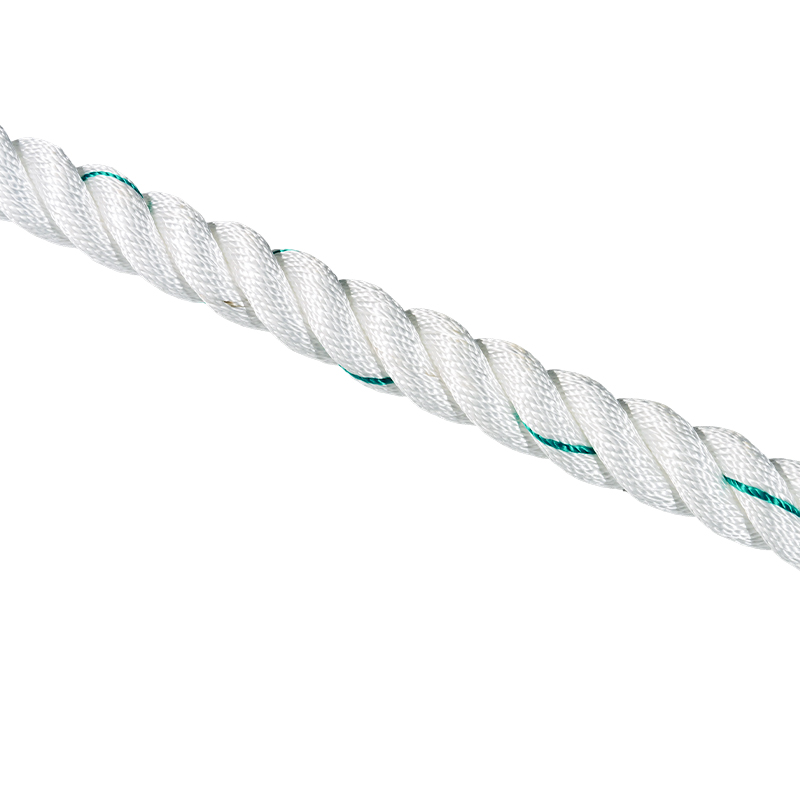
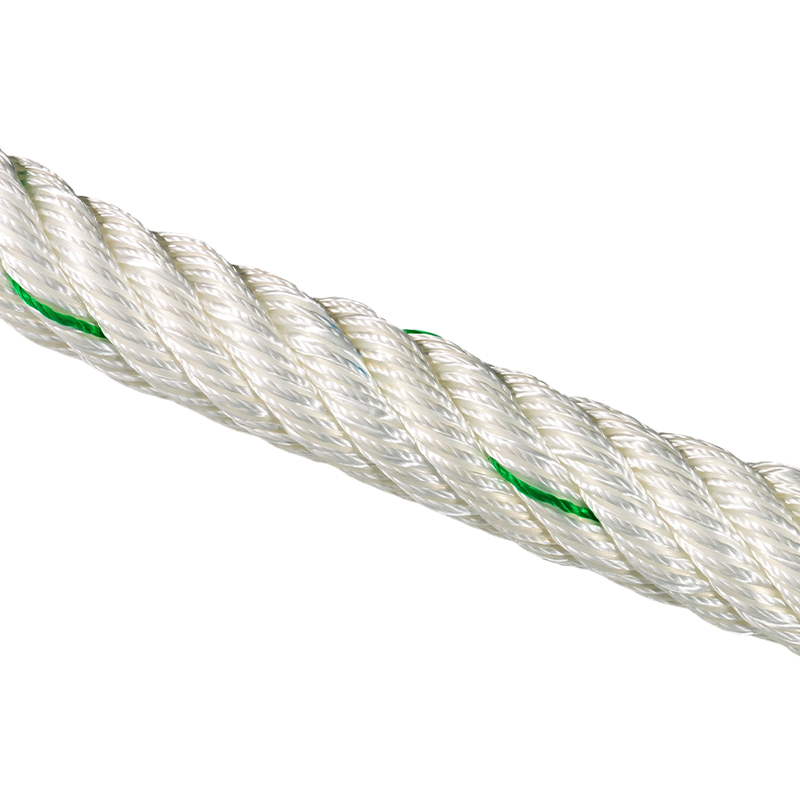
Twisted rope is the traditional three-strand construction where yarns are twisted into strands and strands are twisted together. It is flexible, easy to splice, and economical to manufacture. However, twisted construction is generally less efficient than braid at converting fiber strength into rope strength — a twisted nylon rope will typically achieve around 60–70% of the theoretical fiber break strength.
Double Braid (Braid-on-Braid)
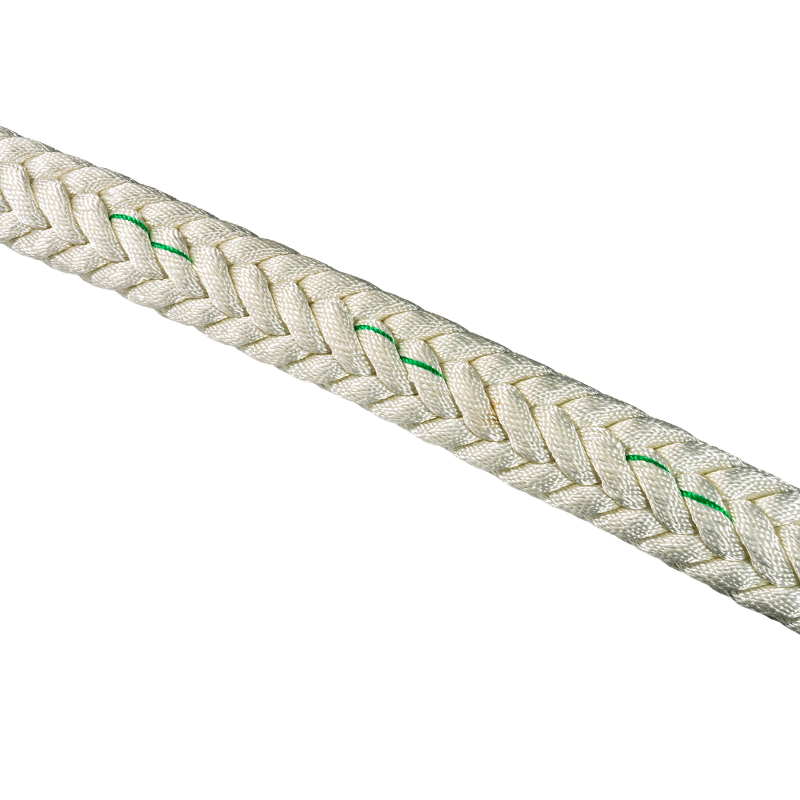
Double braid consists of a braided core enclosed within a braided sheath. This construction is more efficient than twisted rope, typically achieving 75–85% of fiber break strength, and distributes load more evenly across the cross-section. It is well-balanced for general marine, arborist, and rigging applications.
Parallel Core / Single Braid
High-performance ropes such as those used in racing yacht running rigging often feature a parallel fiber core — where fibers run straight along the rope's axis rather than helically — enclosed in a protective woven sheath. This construction achieves high efficiency, converting up to 90–95% of fiber break strength into rope break strength, and produces very low elongation. It is used wherever performance is prioritized over cost and flexibility.
Strongest Rope by Application
The rope for a given task is not always the one with the raw break strength. Other factors — elongation, weight, corrosion resistance, and handleability — often determine which material is the right fit.
Marine and Offshore Mooring
HMPE (Dyneema/Spectra) double-braid or single-braid rope is widely favored for offshore mooring, towing pendants, and high-load running rigging. Its combination of high break strength, low weight, resistance to salt water, and ability to float makes it well-suited to demanding marine environments. High-tenacity polyester is the practical choice for general marina use due to its lower cost and good all-round performance.
Climbing and Arboriculture
Dynamic climbing ropes used in sport and trad climbing are typically constructed from high-tenacity nylon using kernmantle construction, certified to UIAA or EN 892 standards. The intentional elasticity of nylon absorbs the energy of a fall and reduces the peak force transmitted to the climber and anchors. Arborists working aloft use high-tenacity polyester or HMPE for their abrasion resistance and low stretch, which gives more precise load control during tree work.
Industrial Lifting and Rigging
For crane slings and industrial lifting, the choice depends on the environment. Steel wire rope dominates where heat, sharp edges, or long-term sustained loads are involved. HMPE synthetic slings are increasingly used for general lifting where weight and ease of handling are priorities, since they are far lighter than wire rope of comparable break strength and do not corrode. All lifting equipment must be used within the manufacturer's rated working load limit with an appropriate safety factor.
Towing and Recovery
Nylon rope — particularly nylon kinetic energy recovery rope (KERR) — is the preferred choice for vehicle recovery. Its high elongation allows it to store energy during stretching and release it as a smooth tug rather than a sudden jerk, reducing peak load on both vehicles and attachment points. HMPE tow lines are used in marine and heavy commercial towing where low stretch and light weight are more important than energy absorption.
Search and Rescue
Technical rescue ropes are typically kernmantle polyester or nylon, meeting standards such as NFPA 1983 (USA) or EN 1891 (Europe). These standards specify min break strengths — typically 40 kN (approximately 4 tonnes) for a life-safety rope — along with elongation limits and handling requirements. HMPE is used in some rescue systems for haul lines and raising systems where weight savings are critical.
Factors That Reduce Rope Strength in Practice
Understanding the rated break strength of a rope is only part of the picture. Several real-world factors can reduce the effective strength significantly:
- Knots: A standard bowline can reduce break strength by 30–40%; a figure-eight on a bight by around 20–25%. Spliced terminations or mechanical rope grabs are far more efficient.
- Abrasion and wear: Surface damage from running over rough edges or repeated contact with hardware gradually reduces cross-section and strength. Inspect rope regularly for flat spots, glazing, or core exposure.
- UV degradation: Prolonged sunlight exposure weakens synthetic fibers over time. Nylon and aramid are particularly susceptible. Store rope in a cool, dark location when not in use.
- Chemical exposure: Acids, bleach, and many industrial solvents degrade synthetic fibers. Nylon is sensitive to acids; polyester to strong alkalis. Check manufacturer data for chemical compatibility.
- Shock loading: A sudden dynamic load — such as a falling weight coming to an abrupt stop — generates forces many times the static weight. This is why working load limits include a substantial safety margin relative to break strength.
- Bend radius: Running a rope over a sheave or around a pin with a very small diameter significantly increases stress. A rope bent around a pin of equal diameter loses roughly 30–40% of its rated break strength.
How to Choose the Right High-Strength Rope
Selecting a rope for demanding use involves weighing several criteria against each other. The following questions provide a practical framework:
- What is the expected load, and what safety factor is required? Multiply the expected working load by the required safety factor (commonly 5:1 for general use, 10:1 for life safety) to determine the break strength needed.
- Is low elongation or shock absorption more important? Choose HMPE or polyester for minimal stretch; choose nylon where dynamic energy absorption is needed.
- Will the rope be exposed to heat? Aramid or steel wire rope handles high temperatures better than HMPE or nylon.
- Does weight or buoyancy matter? HMPE is the lightest option by strength and the only synthetic that floats.
- What is the budget? High-tenacity polyester delivers strong performance at significantly lower cost than HMPE or aramid.
- Is the rope required to meet a specific standard? Life-safety applications (climbing, rescue, fall arrest) require ropes certified to recognized standards such as EN 1891, EN 892, or NFPA 1983.
Caring for High-Strength Rope
A high-quality rope represents a significant investment, and proper care extends its serviceable life considerably.
- Rinse after salt water use: Salt crystals accelerate fiber abrasion from the inside out. Rinse with fresh water and allow to dry fully before storage.
- Inspect before every use: Look for flat spots, stiffness, discoloration, glazing, or exposed core fibers. Any of these signs warrants closer inspection and possibly retirement of the rope.
- Store out of direct sunlight: UV exposure gradually degrades synthetic fibers. Coil loosely and store in a bag or dry locker away from direct light.
- Keep away from chemicals: Store rope away from fuel, battery acid, solvents, and cleaning agents. Even brief contact with incompatible chemicals can cause invisible damage.
- Retire rope after shock loading: Any rope that has arrested a significant fall or absorbed a major shock load should be carefully inspected and, for life-safety applications, retired regardless of visible condition.
- Follow manufacturer retirement guidelines: Most manufacturers provide service life recommendations based on frequency of use. Life-safety ropes typically have a service life of 10 years from date of manufacture, regardless of condition.
Frequently Asked Questions
Which rope material has the strength-to-weight ratio?
HMPE fiber (Dyneema/Spectra) offers one of the strength-to-weight ratios of any commercially available rope material. A 10 mm HMPE rope can achieve a break strength of 10–14 tonnes while being light enough to float on water — a combination no other common rope material matches.
Is steel wire rope stronger than synthetic rope?
In terms of absolute break strength per diameter, high-performance synthetic ropes such as HMPE can match or exceed steel wire rope. However, steel wire rope has advantages that synthetic cannot replicate: it resists heat, sharp edges, long-term creep under sustained load, and requires no UV protection. The right choice depends on the operating environment, not break strength alone.
What is the strongest knot to use with high-strength rope?
No knot retains 98% of a rope's rated break strength. The figure-eight follow-through and double bowline are among the more efficient knots, typically retaining 70–80% of break strength. For demanding applications, a properly made splice retains 90–95% of rated break strength — significantly more than any knot.
How often should I replace a high-strength rope?
Replacement intervals depend on use intensity, exposure conditions, and the application. As a general guideline, ropes used daily in demanding conditions should be inspected thoroughly every three to six months; ropes used occasionally may remain serviceable for several years. Any rope used in life-safety applications should follow the manufacturer's stated retirement criteria without exception, regardless of apparent condition.
Can I use a stronger rope to increase my safety margin?
Using a rope with a higher break strength does increase the static safety margin, but it does not automatically make a system safer. A stiffer, lower-elongation rope may transmit higher shock loads to anchor points and hardware during a fall or sudden load event. Match the rope's elongation characteristics to the application as carefully as you match its break strength.