2026.10.16
 Industry News
Content
A dock line is easy to ignore until the weather turns. Then it becomes the one piece of gear standing between your boat and the piling next door. The chart below is the same starting point we hand to customers every week: match the diameter to your boat, then adjust for weight, exposure and the way you actually tie up. Get those numbers right and your lines will quietly do their job for years without drama.
Ask ten experienced boat owners how they size a dock line and most will give you the same answer: allow 1/8 inch of diameter for every 9 feet of boat length, with a minimum of 3/8 inch. A 20-foot runabout lands right on 3/8 inch. A 27-footer is still comfortable at 3/8 inch as a floor. A 36-footer calls for 1/2 inch, and a 45-footer generally wants 5/8 inch.
In metric terms the same idea works out to roughly one extra millimetre of diameter for every one to two metres of boat beyond six metres, which is why 10 mm, 12 mm, 14 mm and 16 mm lines cover the great majority of berths in Europe, the Middle East and Asia.
Treat that figure as a starting point, not a verdict. Diameter is really a proxy for two things: the load your boat can put on a line, and how much stretch that line can absorb before it stops recovering. A line that is too thin will stretch past its elastic limit and stay long and limp. A line that is too thick may not fit through your chock, will be stiff to throw and will not absorb shock as gently.
The table below gives practical starting diameters for a sheltered berth, along with the usual metric equivalents and a rough strength range for nylon lines of that size. Breaking strengths vary with material, construction and manufacturer, so treat them as a guide rather than a specification.
| Boat length | Recommended diameter | Metric equivalent | Approximate breaking strength | Suggested working length per line |
|---|---|---|---|---|
| Under 20 ft (under 6 m) | 3/8 in | 10 mm | 3,300–4,200 lbf | 15 ft (4.5 m) |
| 20–30 ft (6–9 m) | 3/8 in, up to 1/2 in if heavy | 10–12 mm | 3,300–7,500 lbf | 20–25 ft (6–8 m) |
| 30–40 ft (9–12 m) | 1/2 in | 12 mm | 7,000–8,500 lbf | 30 ft (9 m) |
| 40–50 ft (12–15 m) | 5/8 in | 16 mm | 11,000–13,000 lbf | 35–40 ft (11–12 m) |
| 50–60 ft (15–18 m) | 3/4 in | 18–20 mm | 16,000–18,500 lbf | 45–50 ft (14–15 m) |
| 60–80 ft (18–24 m) | 7/8 to 1 in | 22–24 mm | 22,000–30,000 lbf | 60 ft (18 m) or more |
Boat length alone ignores the two things that actually break lines: load and movement. Move up one step, and sometimes two, when any of the following applies.
A common mistake is buying lines that are too short. Short lines sit at steep angles, load the cleat at a poor angle and leave almost no elasticity to absorb a surge. Longer lines run at shallower angles, spread the load and soak up movement far more gently.
| Line role | Suggested working length | What it does |
|---|---|---|
| Bow line | Two thirds of boat length plus reach to the dock cleat | Holds the bow in place and limits sideways drift |
| Stern line | Same as the bow line | Holds the stern and works with the bow line |
| Forward spring | Roughly equal to boat length | Stops the boat creeping forward |
| Aft spring | Roughly equal to boat length | Stops the boat creeping backward |
| Spare all-purpose line | About 1.5 times boat length | Covers rafting, towing and unexpected berths |
Four lines is the practical minimum for a permanent berth: one bow line and one stern line on each side, arranged so the boat cannot move fore or aft. Six lines is the usual recommendation for anything you leave unattended, adding a forward and an aft spring.
Diameter gets you into the right range, but the material determines how the line behaves once it is under load.
Nylon stretches further than any other common rope fibre and recovers, which is exactly what you want when a gust or a passing wake yanks the boat sideways. It is the reason nylon has been the default dock line for decades. The trade-off is that the boat moves a little more, which matters in a tight marina.
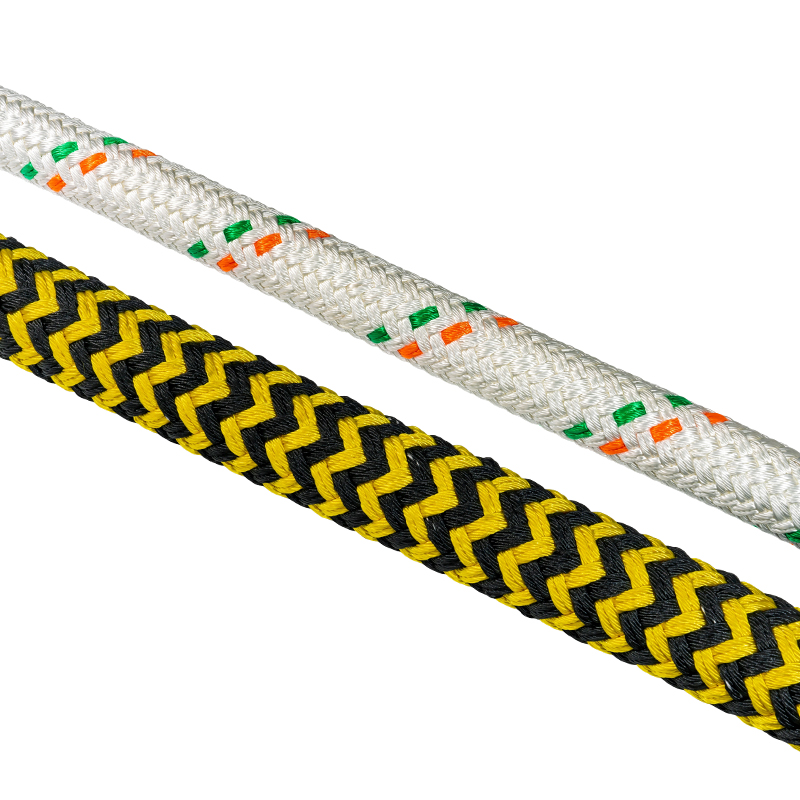 Nylon/Polyamide Double Braided RopeDouble-braided nylon/polyamide rope offers high tensile strength, abrasion resistance, UV protection, and shock absorption for mooring and towing.View Product →
Polyester holds its length under load, resists abrasion and shrugs off sunlight better than nylon. That makes it a strong candidate for permanent moorings, long-term slips and anywhere you want the boat to sit still rather than breathe on the lines. Because it absorbs less shock, pair it with slightly longer lines or a snubber.
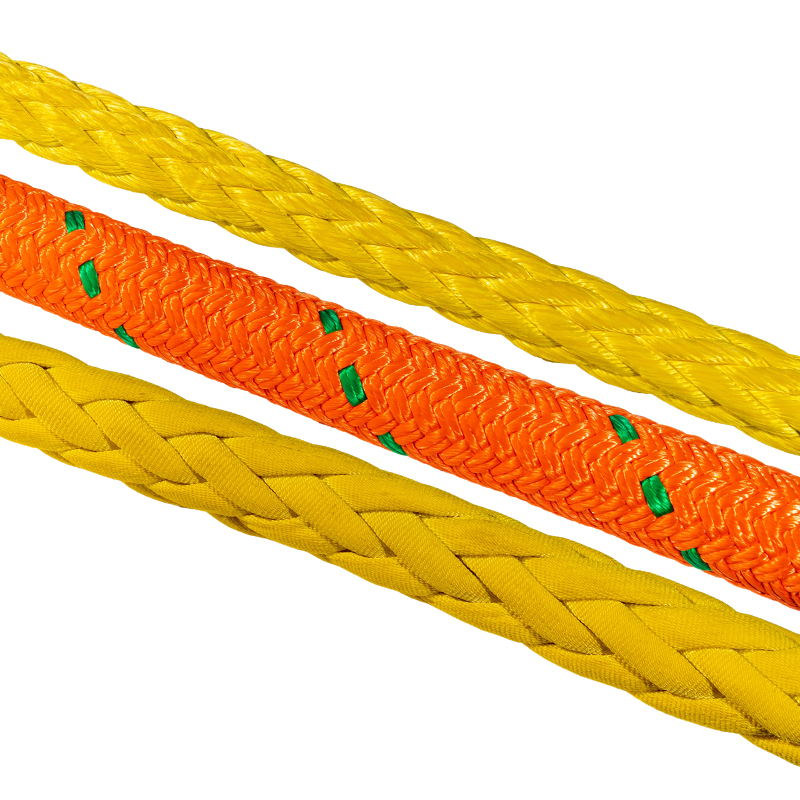 12-Strand Polyester Rope for MooringLow-stretch 12-strand polyester rope resists water and UV, providing stable performance for permanent moorings, port loading, and high-load operations.View Product →
Polypropylene floats, dries quickly and costs less, which suits tenders, inland moorings and light temporary lines. It is weaker than nylon or polyester for the same diameter and degrades faster in strong sun, so it rarely belongs on a heavy boat in an exposed berth.
 Polypropylene Double Braided RopeLightweight, UV-resistant double-braided polypropylene rope handles saltwater and chemicals, suiting naval, shipping, offshore, and fishing applications.View Product →
Ultra-high molecular weight polyethylene offers very high strength for very little weight and almost no stretch. It suits workboats, heavy berths and applications where a thin, strong line is essential, though it generally benefits from a nylon tail to restore some shock absorption.
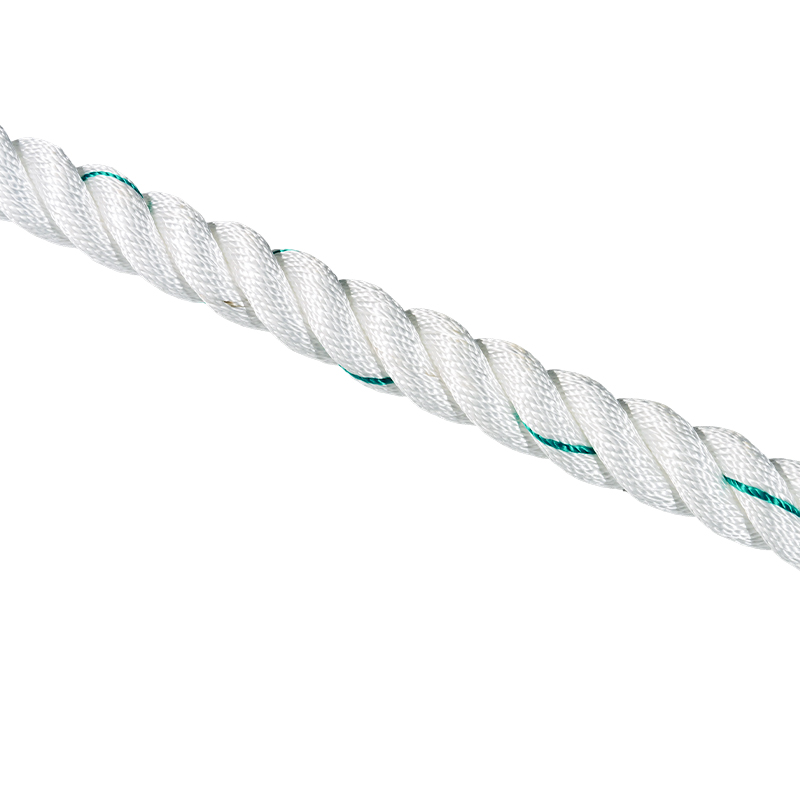
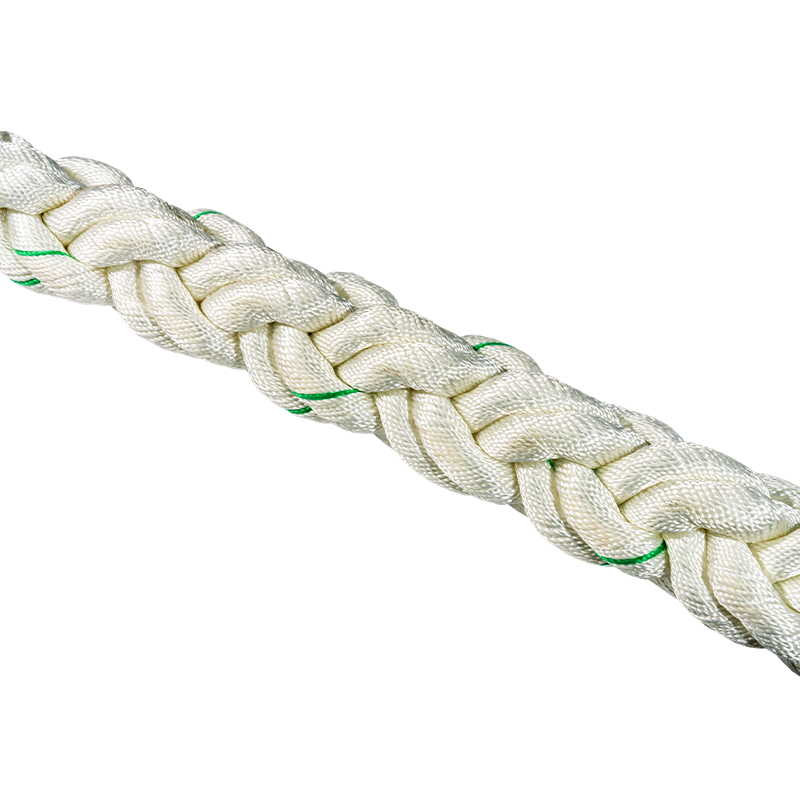
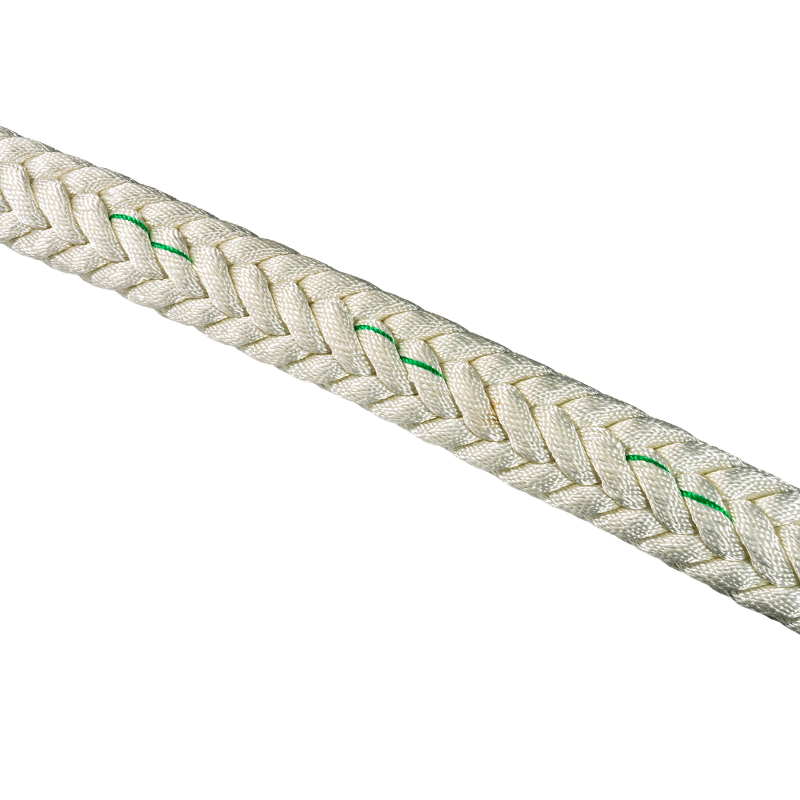
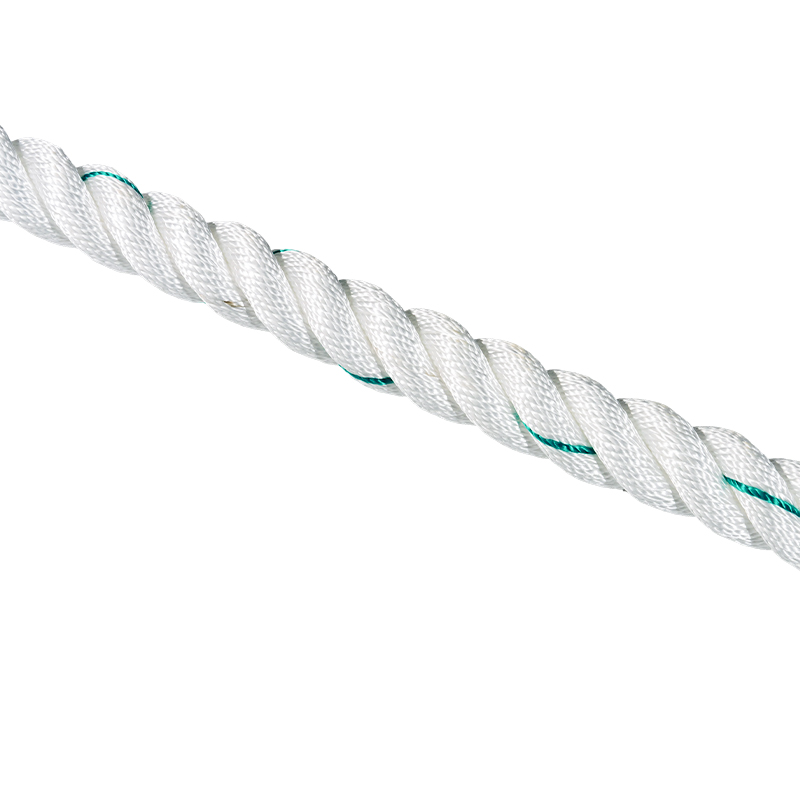
Three-strand lines are affordable, easy to splice and forgiving of chafe, while double braid constructions handle better, resist abrasion at the cover and hold their shape over years of use. If you are weighing up the two, we wrote a fuller comparison of braided versus twisted construction that covers strength, elongation and where each one earns its place.
A number on a chart is a breaking strength, measured in a test rig on a new, dry line. What matters at the dock is the working load, which should be a comfortable fraction of that figure. As a rule of thumb, keep the load you expect in normal conditions below one fifth of the breaking strength, and closer to one tenth if the berth is exposed or the line is left in place for years.
Two further cautions. Wet lines lose a little strength and gain a little stretch compared with dry ones, which is normal and already reflected in the ranges above. And a splice, knot or sharp bend can cut the effective strength of a line noticeably, which is why spliced eyes and smooth chocks beat knots wherever you can use them.
Three-eighths of an inch is the minimum, and half an inch, about 12 mm, is the comfortable choice for most 30-foot boats. If the boat is heavy or the berth is exposed, go to 5/8 inch.
Slightly slack is correct. Aim for enough slack that the boat can rise and fall with the tide and surge, but not so much that it can build momentum. Lines pulled bar tight transfer every surge straight into the cleat, the deck and the line itself.
Bow and stern lines usually work best at about two thirds of the boat length plus the distance to the dock cleat, while spring lines are typically close to the length of the boat. When in doubt, buy longer and take up the excess at the cleat.
Inspect them at the start of every season. Replace any line with a glazed, stiff or flattened section, visible core, or heavy chafe at the chock, and plan on replacing working lines every three to five years in strong sunlight.
Sizing a dock line comes down to three decisions: diameter from boat length and displacement, length from the geometry of your berth, and material from how much movement you want to allow. Once those are settled, the rest is routine maintenance and a habit of checking chafe points whenever you step aboard.
We build marine ropes in Yangzhou, Jiangsu, from 6 mm up to 160 mm, in nylon, polyester, polypropylene and UHMWPE, in three-strand, eight-strand, twelve-strand and double braid constructions. Our lines carry ISO 9001 quality management and class approvals from CCS, BV and LR, and we regularly supply boatyards, marinas and marine contractors who need a specific diameter rather than an off-the-shelf length. If you would like to see how these ropes behave on real berths and working vessels, take a look at our applications and cases pages, or send us your boat length, displacement and berth details and we will suggest a starting size.
Mar 12. 2026
What Are the Most Common Practical Uses for Polypropylene Rope?Core Applications of Polypropylene Rope in Marine and Water Activities In the modern rope industry, Polypropylene Rope (often referred to as “PP rope” or “floating rope”) has become an irreplaceable tool for water-based ...
Read MoreMar 12. 2026
Polyester Rope Guide: Types, Uses, Strength & Buying TipsPolyester rope is one of the most versatile and reliable cordage options available today. It outperforms nylon in UV resistance, holds its strength when wet, and stretches far less under load — making it the preferred c...
Read MoreMar 13. 2026
What is polyester rope and why is it the best choice for most applicationsWhat Is Polyester Rope? Understanding the Basics Polyester rope is one of the most widely used synthetic ropes in the world today, valued across industries for its exceptional balance of strength, durability, and resista...
Read More


 English
  русский
  Español
  عربى
عربى