2026.05.21
 Industry News
Content
Not all ropes are created equal. Whether you're rigging a load-bearing safety line, anchoring a vessel, building suspension infrastructure, or outfitting a climbing route, the rope material you choose determines everything: how much force it can withstand before failure, how it responds to impact, whether moisture or UV radiation degrades it, and how long it will last under repeated stress. Understanding what makes a rope material strong — and which materials the field — is essential for anyone working where failure is not an option.
Rope strength is commonly quoted as breaking strength — the tensile force required to snap a rope under a steady load. But that single number hides important complexity. A rope used in dynamic situations, such as rock climbing or crane rigging, must also absorb sudden shock loads without failure. The relevant property here is toughness: the ability to absorb energy during deformation. A material with extremely high tensile strength but low elongation can shatter under a sharp impact load even if it resists slow, steady tension beautifully.
Two additional metrics shape real-world performance: specific strength (breaking strength divided by weight per unit length) and stiffness (resistance to stretch). High-performance synthetic fibre ropes routinely achieve specific strengths five to fifteen times greater than steel by weight, which is why they have displaced wire rope in many aerospace, marine, and industrial applications.
Specific strength — strength per unit of weight — is often more relevant than raw tensile strength. A rope that is both lighter and stronger than steel per kilogram allows engineers to use less material, reduce structural loads, and increase safety margins simultaneously.
Ultra-high-molecular-weight polyethylene, sold under brand names including Dyneema, Spectra, and Plasma, is the strongest rope material available by weight for the vast majority of real-world use cases. Its molecular chains are aligned in a highly parallel arrangement during a gel-spinning process, producing a fibre with tensile strength of 2.0–3.7 GPa and a specific strength roughly 8–15 times greater than high-carbon steel wire.
The practical consequences of that number are significant. A UHMWPE rope with a breaking strength of 100 kN weighs a fraction of the equivalent steel wire rope, reducing the structural load on the hardware and rigging it connects to, and making it far easier and safer for workers to handle manually.
In offshore oil and gas, oceanographic research, and naval mooring, UHMWPE mooring lines have largely displaced wire rope because they float, eliminating the catenary weight that causes wire systems to snap under sudden tension. In arborist rigging, lightweight high-strength lines let climbers work faster with less fatigue. In search-and-rescue, teams can carry ropes strong enough for vehicle extractions in a fraction of the previous pack weight.
UHMWPE also resists chemicals, absorbs virtually no water, and has a coefficient of friction low enough to run smoothly over pulleys without the sheath wear that degrades aramid fibres. Its weakness is temperature: softening above approximately 80–100°C means it is unsuitable for fire-adjacent applications or environments with sustained elevated heat.
A 12-strand single braid of UHMWPE typically achieves 85–95% of theoretical fibre strength. Double-braid or kernmantle constructions trade some peak strength for better handling and abrasion resistance. Spliced terminations preserve more strength than knots — knots reduce UHMWPE rope strength by 30–50%.
Polybenzoxazole fibre, marketed as Zylon, holds the record for tensile strength and tensile modulus among commercially produced organic fibres. A single filament can withstand stress up to 5.8 GPa in laboratory conditions, and rope constructions routinely test above 3.5 GPa. For purely static, indoor, light-protected applications, PBO is unmatched.
The critical limitation is its photodegradation. Exposure to UV light — including ordinary daylight — and ambient moisture causes PBO fibres to hydrolyse rapidly. Safety regulators withdrew PBO from many certified life-safety applications after incidents where ropes tested fine in storage but failed under service loads after brief outdoor exposure. It remains widely used in aerospace structures where it is permanently enclosed, and in motorsport roll-cage nets where replacement intervals are closely managed.
PBO/Zylon ropes and slings should never be used in outdoor or UV-exposed settings without verified UV protection and strict replacement schedules. The strength degradation is not visible to the naked eye — a rope that looks intact may have lost 30–50% of its rated strength after a season of outdoor exposure.
Aramid fibres fail under repeated bending around tight radii, a property called compressive fatigue. Unlike UHMWPE or polyester, aramid fibres are inherently brittle in compression — the individual filaments crack and fracture when forced to bend sharply, which is why aramid ropes are rarely used in systems with small sheave diameters. They also absorb UV radiation, degrading over months of unprotected outdoor exposure. Proper sheathing in a polyester braid significantly extends service life but adds weight.
| Material | Tensile Strength | Strength-to-Weight | Stretch | UV Resistance | Best Use |
|---|---|---|---|---|---|
| UHMWPE (Dyneema) | 2.0–3.7 GPa | Exceptional | Very low (~3%) | Good | Marine, rescue, arborist |
| PBO (Zylon) | 2.7–3.6 GPa | Exceptional | Very low (~2.5%) | Poor | Aerospace, motorsport |
| Para-Aramid (Kevlar) | 2.8–3.6 GPa | Very High | Low (~3.6%) | Moderate | Fire, military, industrial |
| Vectran (LCP) | 2.9–3.1 GPa | Very High | Minimal (~3%) | Moderate | Precision / aerospace |
| Polyester (PET) | 0.9–1.5 GPa | Good | Low (~10%) | Very Good | Marine standing rigging |
| Nylon (PA) | 0.7–0.9 GPa | Moderate | High (15–40%) | Moderate | Climbing, towing, anchors |
| Steel Wire Rope | 1.0–2.0 GPa | Moderate | Very low (~1%) | Excellent | Crane, construction, elevator |
The fibre is only half the story. The way fibres are twisted, braided, or laid into a rope structure profoundly affects the final product's performance. A given fibre's theoretical strength is rarely fully realised in a rope construction — mechanical efficiency depends on geometry.
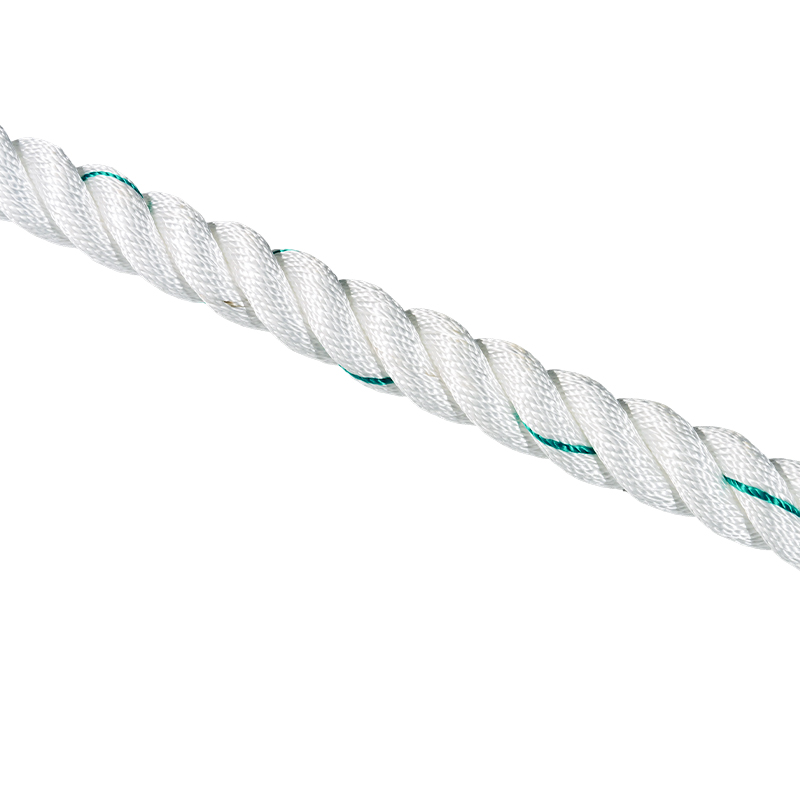
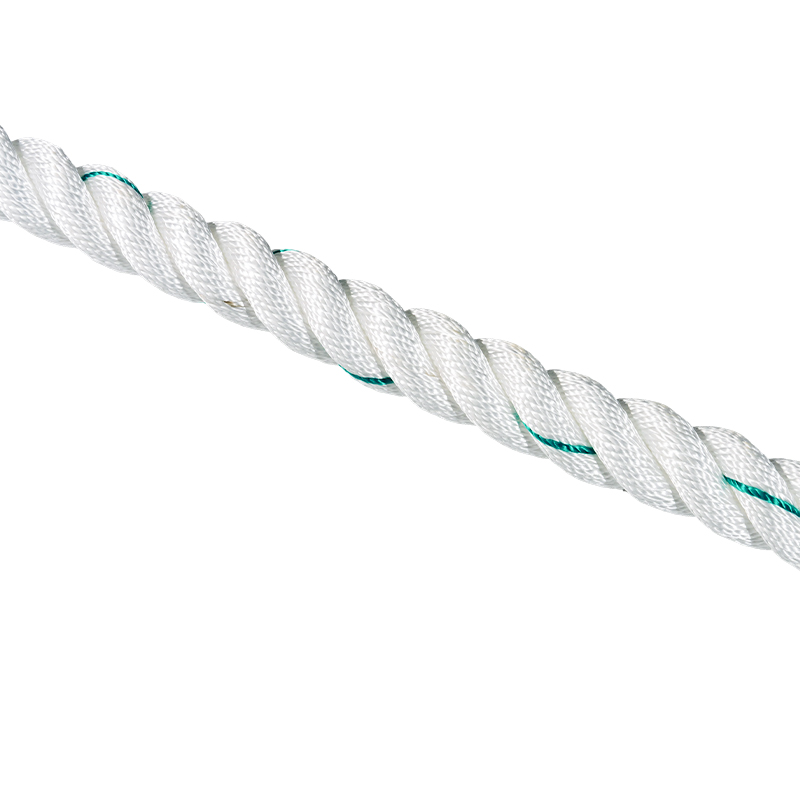
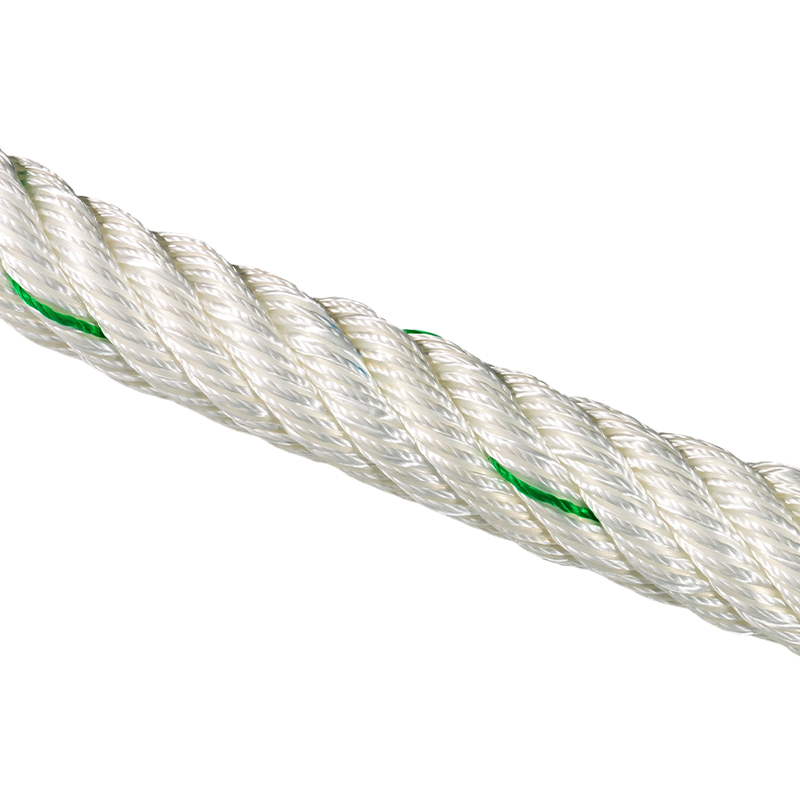
The traditional three-strand twisted construction transmits tension through helical fibre paths. Each fibre's angle to the load axis means only a portion of its tensile capacity contributes to the rope's strength. Laid ropes are easy to splice and inspect for damage but typically achieve 60–75% of fibre strength in practical constructions.
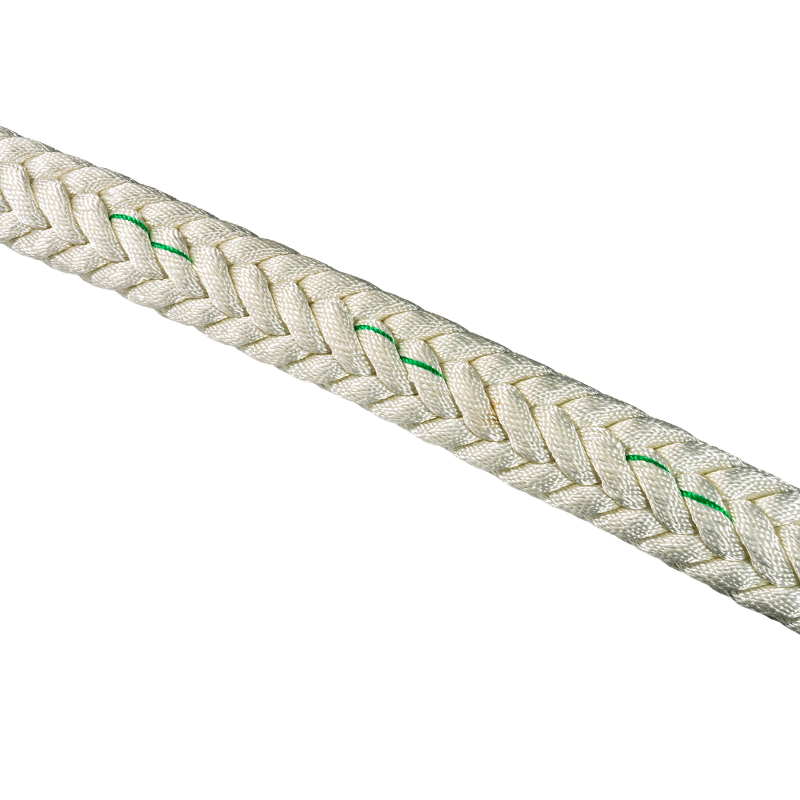
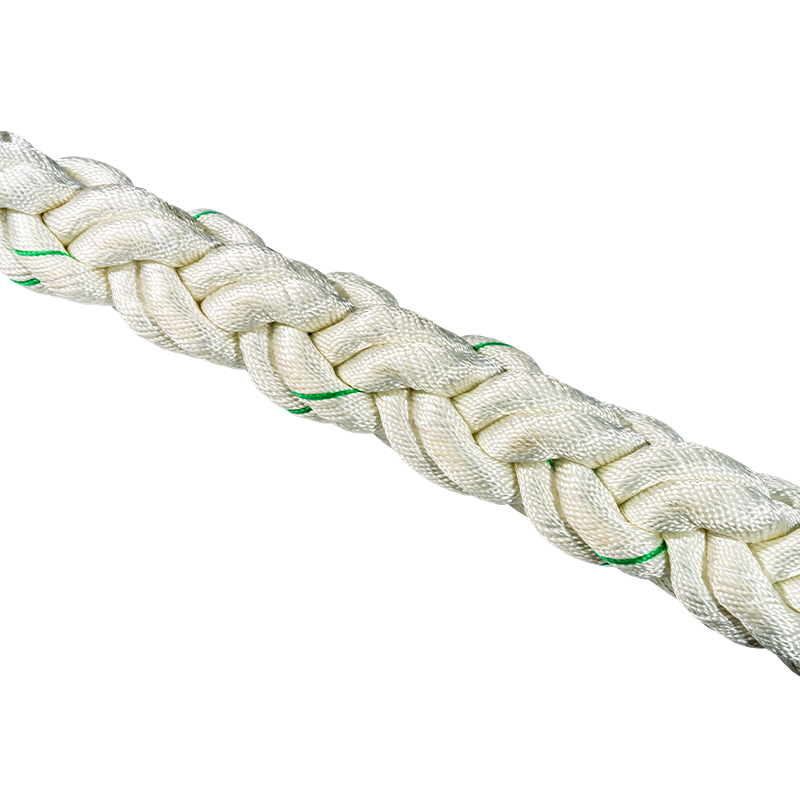
Eight-strand and twelve-strand single braids allow fibres to run at lower angles to the rope axis, improving mechanical efficiency to 80–90% of fibre strength. Double braid (braid-on-braid) constructions add a braided sheath over a braided core. The sheath protects the load-bearing core from abrasion and UV while contributing some additional load capacity. Twelve-strand single braid is the dominant construction for UHMWPE and Vectran in demanding applications because it combines high efficiency with good resistance to kinking.
Some ultra-high-performance ropes — particularly in sailing and aerospace — use parallel-fibre cores in which the load-bearing fibres run in a nearly straight line along the rope axis, covered only by a protective braid. These constructions approach 95% fibre efficiency but offer almost no elongation, no tolerance for tight bends, and are sensitive to core damage that is invisible from outside the sheath.
Any knot introduces sharp bends and fibre compression that drastically reduces rope strength. A bowline reduces breaking strength by approximately 30–40%; an overhand knot by up to 50%. In high-performance synthetic ropes, mechanical terminations (thimbles, swaged fittings, or splices) are strongly preferred — a well-executed splice in UHMWPE typically retains 90–95% of rated strength.
The strongest rope material in absolute terms is rarely the material for a given job. Selecting the right rope requires weighing strength against elongation behaviour, UV exposure, operating temperature, abrasion risk, budget, and the consequences of failure.
The frontier of rope material science is currently being pushed by carbon nanotube (CNT) fibres and graphene-based composites. Individual carbon nanotubes have theoretical tensile strengths exceeding 100 GPa — roughly 30 times greater than the current commercial fibres. The challenge lies in translating individual filament properties into macroscopic ropes: defects, alignment irregularities, and inter-fibre load transfer all degrade bulk strength considerably.
Several research groups and commercial ventures have produced CNT yarns with tensile strengths in the 1–9 GPa range — comparable to or exceeding UHMWPE — at small scales. The next decade will likely see CNT-reinforced hybrid ropes move from laboratory curiosity to niche commercial products, initially in aerospace and defence applications where performance justifies cost.
Bioinspired materials also show promise. Spider silk — specifically the dragline silk of orb-weaving spiders — combines tensile strength approaching 1.5 GPa with extraordinary toughness and elasticity in a single natural fibre. Recombinant spider silk proteins are now being produced at scale by several biotechnology firms, and the engineered spider silk ropes have entered testing for surgical and soft-robotics applications.
The question of which is the strongest rope material does not have a single, universal answer — but it does have a principled one. For the broadest range of load-bearing applications, UHMWPE in a well-constructed twelve-strand braid, terminated with proper splices, represents the current gold standard: unmatched strength-to-weight, chemical and moisture resistance, and a proven track record across marine, rescue, arborist, and industrial sectors worldwide.
For thermally demanding environments, para-aramid fibres remain indispensable. For applications where dimensional stability under sustained load is paramount, Vectran has no peer. And wherever shock absorption is the primary design requirement, no high-tenacity fibre matches the energy-absorbing elongation of engineered nylon.
Understanding the full performance profile of each material — not just the breaking-strength headline — is what separates a rope that holds from a rope that fails. In any application where a rope carries weight, anchors a life, or holds structure together, that distinction is everything.
Mar 12. 2026
What Are the Most Common Practical Uses for Polypropylene Rope?Core Applications of Polypropylene Rope in Marine and Water Activities In the modern rope industry, Polypropylene Rope (often referred to as “PP rope” or “floating rope”) has become an irreplaceable tool for water-based ...
Read MoreMar 12. 2026
Polyester Rope Guide: Types, Uses, Strength & Buying TipsPolyester rope is one of the most versatile and reliable cordage options available today. It outperforms nylon in UV resistance, holds its strength when wet, and stretches far less under load — making it the preferred c...
Read MoreMar 13. 2026
What is polyester rope and why is it the best choice for most applicationsWhat Is Polyester Rope? Understanding the Basics Polyester rope is one of the most widely used synthetic ropes in the world today, valued across industries for its exceptional balance of strength, durability, and resista...
Read More


 English
  русский
  Español
  عربى
عربى